Showing posts with label homebrewing. Show all posts

Friday, August 16, 2013

Best Bib and a Tucker

Thought for the day:  Put on your best bib and tucker.

I LOVE MOMMY bib
 Here's a picture of one of my favorite bibs. (Of course, it'd be even better if it said, I love grandmommy.) That cute little fella wearing it is our grandson Aaron, and the picture was taken almost three years ago, so he doesn't need to wear a bib any more.

Know what a tucker is? It's a lacy piece of cloth worn by modest women in the 18th and 19th centuries to cover their cleavage decorate their neck area. The cloths tucked into a woman's dress and extended to the top of her neck. (And wearing your best bib and tucker means to dress in your finest clothes.)

But that's not the kind of tucker I was hoping to see last weekend. (Nope, that was just a silly lead-in.)

I know a lot about cars, man. I can look at a car's headlights and tell you exactly which way it's coming. [Mitch Hedberg]

Do you know enough about cars to recognize this one? It's a 1948 (ta- DA!) Tucker, courtesy of Wikipedia. Alas, the one I was hoping to see in person was gone. Sold right out from under me. So to speak.

But fear not. There were plenty of other beauties to see.


Okay, so maybe not this one. This one, um, needs a little work. A fixer-upper. (But it has lots of potential, dontcha think? )
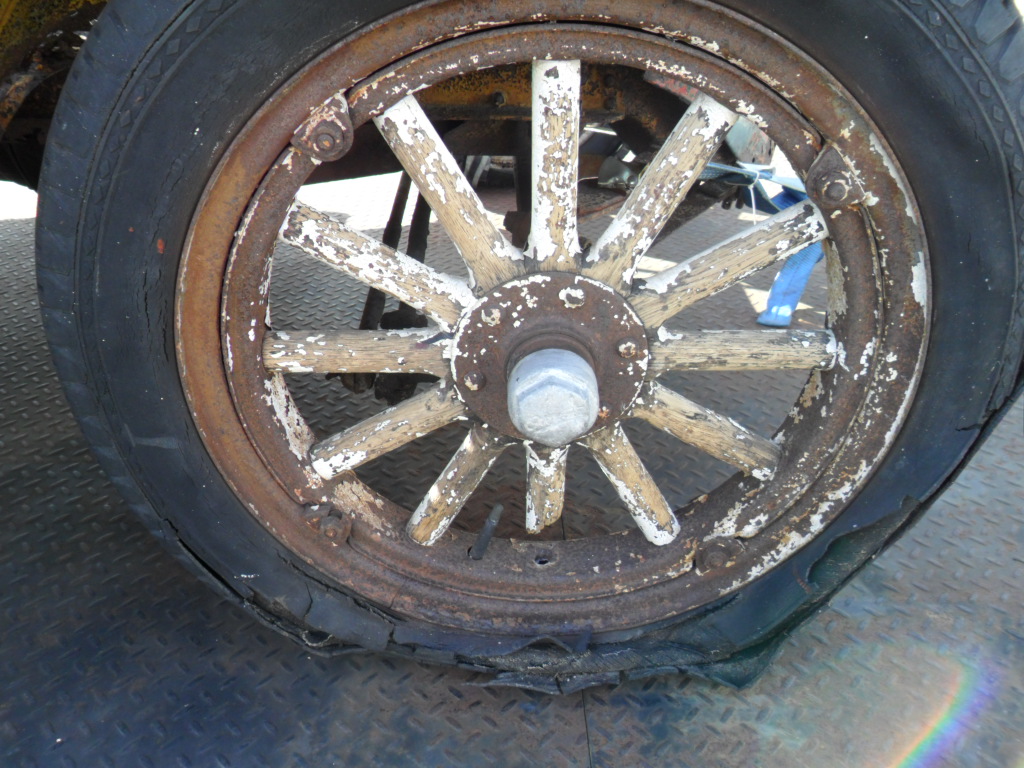


A close-up of one of the fixer-upper's wheels. In case you can't tell, the spokes are made of wood.


So where did we go to see both fixer-uppers and beauties? The annual Model A swap meet. This was the third year we attended, and the second time we drove there in my hubby's 1930 Model A rat rod. Unfortunately, in spite of the sign indicating reserved parking for Model As only, so many interlopers were allowed to park there, we had to park elsewhere. Bummer.


This Model A was there last year, too, and it's still one of my favorites. I LOVE the colors. Very classy-looking.


What was kinda neat about this one is how the flags are mounted on front. With springs as holders. Clever, huh?


The real show-stopper vehicles were inside. The annual Model A swap meet, held outside the warehouse, marks one of the few times of the year when the public is invited inside to see the Cofer family's stable of award-winning vehicles.


Rows and rows of gorgeous vehicles, shiny, immaculate, and better-looking than when they were new. If you're interested, a simple Google search should take you to a site where you can take a gander at all of them. The collection is world-renown.


This sign would fit right in at a brothel, wouldn't it?


Of course, this is the kinda Woody the sign was actually referring to.


Here's a slightly closer shot of the wood paneling, but not close enough to do it justice. Rich wood with a mellow glow... and the pieces are joined together beautifully with dovetail joints.


Yeah, I posted a pic of this last year, too, but it's still one of my favorites. An Indian motorcycle... with a sidecar. And it's RED! (What's not to like?)


Any of you guys remember this? A Whizzer. (If you had one, I wanta hear about it!)


Anybody recognize this one? (Hint: the flux capacitor isn't included.)


Time to head home. This is a rear view of the rat rod. Smarticus made the cedar bed out of our old hot tub. Pretty neat, huh?

A side view.  What she may lack in aesthetic beauty, she more than makes up for in good old-fashioned fun. And I'm proud to say, Smarticus did all the work himself. All he started with was an original 1930 rusted cab. Yeah, it was a major fixer-upper.

A lot of the pristine vehicles we see at various car shows have signs on them saying, "Do not touch." The owners are forever spraying and wiping, lest a dust mote or fingerprint dare mess up their perfect paint jobs. That's all well and good, but not exactly our style. We once had a "Do not touch" sign on her at one of the shows, too, just for a laugh. We told people we didn't want THEM to get dirty.

And so we come to the end of another fine adventure on another hot summer day in Georgia. Well, almost the end. We still had the drive home... and believe you me, a ride in the rat rod is always an adventure in itself. And we were both... tuckered out.


Until next time, take care of yourselves. And each other.

Tuesday, April 10, 2012

Putting It All Together

Thought for the day:  Fundamentals are the building blocks of fun.  [Mikhail Baryshnikov]

[THEME: Amateur radio]

Ever hear of an INTEGRATED CIRCUIT?

Know what it is? Basically, it's a single piece of semiconductor material (i.e. silicon or germanium) that's used in an electronic circuit in place of a bunch of individual components.

Kinda like if you were building with Lego blocks. (Oh, you KNOW you love 'em!) Let's say you had a big bag of itty bitty blocks to put together. Sure, you could pull out your handy dandy magnifying glass and do it, of course, but what if some of those blocks were already put together for you into larger units? Things would suddenly become a lot easier, wouldn't they?

With integrated circuits, that's exactly what manufacturers do. They put some of the components together for you. They put the components within the semiconductor material, and in such a manner that the IC performs a specific function within the circuit. Oh, and because of the piece, or chip, of silicon within these devices, ICs are also know as ... chips.


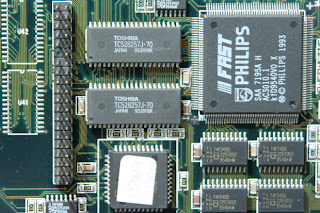
How many of these components can you identify?

In the picture above, the ICs are mostly clustered in the lower left hand corner, but the little red jobbie to the left of the LEDs is one, too.

Some ICs may only have a few components; others may have hundreds, or even thousands. (Whew! Talk about saving builders a TON of soldering!) Some are general-purpose chips; others are very specialized, and designed for one specific purpose within a circuit. It isn't a stretch of the imagination to call ICs electronic building blocks.

I'll bet you can pick out the ICs on this circuit board.


And this one.

The upside to ICs? They make life a lot easier for builders, and they're extremely space-efficient, which is one  reason commercially-produced electronic appliances and gadgets are so much smaller than they used to be.

The downside? If a component within an IC in your electronic appliance or gadget goes belly up, you may be outta luck. As technology advances, and IC designs mutate, the exact IC may no longer be readily available, so it may cost less to replace an item than have it repaired. More and more, these items are being considered throwaways ...


                                                              to SOME people.


Monday, April 9, 2012

Brewing Up Some Fun

Thought for the day:  Creativity is inventing, experimenting, growing, breaking rules, making mistakes, and having fun.  [Mary Lou Cook]


[THEME: Amateur radio]

Today, it's all about HOMEBREW.


Um, not THIS kind.

Well, yeah, I suppose amateur radio operators could brew their own adult beverages, but the kind of homebrew I'm talking about is equipment ... equipment they build with a healthy dollop of ingenuity, odds and ends from their junk boxes, and their own two hands. (Or perhaps with an all-parts-included kit, and a keen ability to follow instructions.)

In the early days of radio, amateurs had little recourse but to build their own stuff. Very little was available commercially, and what was available was too high-dollar for most to afford. So amateur radio enthusiasts started out with a can-do do-it-yourself attitude that remains with many in the hobby today. 

I'm no master builder, but I've even built a few things.

Like this simple crystal set. And I only bloodied my fingers a little bit while unkinking and winding the wire around that piece of PVC pipe, too. (My helpful hubby told me after the fact that I should've fed the wire through a vice.) Anyhow, a crystal set is easy enough for a child to build, and hey! It's "free radio!" (Man, I need to get the "maid" to dust that thing!)

I've also built a 20M CW receiver and matching transmitter. That was a lot of fun, too, because I had to learn how to differentiate the components, and even got to be pretty darned good with a soldering iron. Once they were completed, and we verified that they actually worked (!) I set them aside. Where they are now? Beats me. For me, the fun was in the building. The only other thing I've ever built was a really neat antenna to use for fox hunting. That was fun, too, but I ended up donating it to an auction to raise money for a scholarship. Surprised me. Once the guys learned I was the one who built it, some of them actually WANTED it. How cool is that? A "bidding war" just because their "illustrious" Section Manager built the thing. Still amazes me.

But my husband is the REAL builder in the family. He can build darned near anything, and has an extensive collection of  equipment and parts. (A junk box extraordinaire.) When a visiting South African ham toured our house,  his eyes got bigger and bigger, and he kept saying, "Holy cow!"  Finally he declared, "Radio Shack must send people to YOU!" 


At left is an antenna tuner my hubby built. Cool, huh? That's a shot of it from the front.


                                                  And here's a picture of it from the TOP ...


Yeah, he built it on a wooden toilet seat lid. (He has a wacky sense of humor, too, which is one of the reasons we get along so well.)


This is a less-than-stellar shot of one of the more-than-stellar amplifiers he built. It is B-I-G and with the tubes he put in it, should pretty much last forever.


But amateur radio projects don't have to be B-I-G. Many hams enjoy building tiny CW transmitters inside of Altoids cans, and if you can believe it,  in even smaller containers than that. These little transmitters are for operating QRP, or low power. (around 5 watts) Some transmit on even less power, and that's called  QRPP. (I know. Makes me giggle, too.)

Amateurs love to build and experiment with antennas, too. This picture appeared on our radio club's Facebook page, and the fella who posted it gave me permission to use it. It was taken in the '50s of his wife's uncle, playing with an antenna he'd built and designed.


Today's amateurs have access to all kinds of equipment, both new and used. Some radio clubs even have loaner radios to help new hams get on the air. So, bottom line is, nobody HAS to build his own equipment nowadays. But then again, nobody HAS to make his own wine, either. But for a lot of people, homebrewing is too darned much fun to resist.