Showing posts with label butterflies. Show all posts

Friday, October 18, 2019

Cause and Effect

Thought for the day: We cannot live for ourselves alone. Our lives are connected by a thousand invisible threads, and along these sympathetic fibers, our actions run as causes and return to us as results. [Herman Melville]

Are you familiar with the butterfly effect? I took that picture on the left when we were at a butterfly festival, where a monarch butterfly took up residence on the top of my head for a good while. It was actually very cool, but the effect that particular butterfly had on me after doing his itty bitty business on my head is... when we got home, I washed my hair.

But um, that isn't a bona fide example of the butterfly effect. In essence, the actual effect, or principle, says that a tiny change within a complex system may have a huge effect. Originally, the phenomenon was ascribed largely to weather, in which American mathematician and meteorologist Edward Lorenz, who established the chaos theory, as well as theories regarding weather and climate predictability, offered the metaphorical example of how the specifics of a tornado's path could be influenced by something as minor as the flapping of a butterfly's wings.

It speaks to our larger expectation that the world should be comprehensible... that everything happens for a reason, and that we can pinpoint all those reasons, however small they may be. [Peter Dizikes, journalist]

[image courtesy of wikipedia]
Just to be different, I'm going to go in the opposite direction. Instead of moving from a tiny cause leading to a huge effect... I'm going the other way. I'm going to start with a mastodon. 

Can't get much bigger than that!

Would you believe that something these behemoths did back in prehistoric times contributed to the survival of a tiny butterfly still living in Georgia today?

[image courtesy of wikipedia]

The paw paw tree is fairly common here in Georgia. In the springtime, its flowers are quite lovely, but they, um... STINK. Literally. Kinda like dead fish or rotting meat. Matter of fact, the leaves and bark have the same distinctive stench.

But these trees also produce a fruit, as shown in this picture, and it's the largest edible fruit indigenous to the U.S. They range in color from a yellowish-green to brown, and their insides are creamy and similar in taste to banana custard. Or so I've been told. I've never eaten one.

[image courtesy of wikipedia]
But lots of animals devour them. But they only eat the sweet fleshy part.

See, the seeds range in size from 1/2 to 1 inch, which is too large for any living animal to swallow whole.

Not a problem for our ol' pal the mastodon.


Mastodons gobbled 'em up, seeds and all... and then they continued their meanderings around the state. What goes up must come down, and what went in had to come out.

Meaning, as these mastodons wandered around the state, they um, sowed these undigested seeds wherever they went, and thus assured the spread of this species. The diet and excretion of these creatures from eleven thousand years ago directly led to the paw paw patches that are still seen around the state today. But how about that... tiny effect I mentioned earlier?

[image courtesy of wikipedia]

Meet the zebra swallowtail. Yep, a butterfly.

The only thing its caterpillar will eat is the foliage from a paw paw tree. So, no mastodon poop containing paw paw seeds, possibly no paw paw trees today, and no zebra swallowtails.

One thing kinda interesting about these butterflies. The stink I mentioned from the trees? It comes from a chemical, a naturally-occurring insecticide called acetogenins, and after eating the stinky foliage while in the caterpillar stage, the butterflies retain a trace amount of the substance for the rest of their lives, which provides an effective protection from predators, who evidently, don't like smelly food.


So, in essence, this lovely little butterfly, which we saw at the festival, owes its existence, in part, to the eating and pooping habits of a creature which lived in the very distant past.


Cool huh?


There is a deep interconnectedness of all life on earth, from the tiniest organism to the largest ecosystem, and absolutely each person. [Bryant McGill]

The moment you realize your bones are made from the same dust as the planets, your lungs breathing the air of migrating butterflies, and your blood is pumping because of the love and care of thousands is when you realize you're not as broken or alone as you think you are. You are full of the world. [source unknown]

Learn how to see. Realize that everything connects to everything else. [Leonardo da Vinci]

Cosmos is a Greek word for the order of the universe. It is, in a way, the opposite of chaos. It implies the deep interconnectedness of all things. It conveys awe for the intricate and subtle way in which the universe is put together. [Carl Sagan]

                                                Another kind of paw paw flower...

[image courtesy of unsplash]


                                 Until next time, take care of yourselves. And each other.

Friday, July 20, 2018

I'll Fly Away

Thought for the day: What the caterpillar calls the end of the world the master calls a butterfly. [Richard Bach]

[image: morguefile]
It'd be kinda cool if we could eat and eat and eat until we're too fat to move, and then sleep for a while, only to wake up transformed into a beautiful creature. With wings!

Yeah, not gonna happen. With my luck, I'd morph into a cockroach. (shudder)

Anyhow, July 21 - 29 is recognized around the world as National Moth Week, so I thought this would be a good time to take a little flit around the Lepidoptera family with you. Although moths make up from 89 to 94% of this family,  most of us are much more familiar with butterflies. Why? Easy. They flutter through our gardens during the day and their brightly-colored wings are usually very beautiful. We associate them with flowers and summertime, and in general, most of us like them. Moths, on the other hand, tend to be rather drab and do most of their flying at night, and we associate them with devouring our trees and snacking on our favorite woolen sweater. (They really do need to get a better PR team!) However, like butterflies, moths also play an important role in plant pollination.

[image: seniorark]


Other differences between moths and butterflies:

  • Butterflies have antennae that are club-shaped with a long shaft, while moths have feathery or saw-edged ones.
  • Moths fold their wings in a tent-like manner to cover their abdomens, while butterflies raise them vertically over their backs.
  • Moth larvae develop in silk cocoons, while butterflies build a more hard-shelled chrysalis.
  • Moths have a gizmo called a frenulum, which couples their wings, allowing them to work in unison. Butterflies do not.
  • When you were a child, did adults dissuade you from handling butterflies and moths by saying they wouldn't be able to fly if you dislodged some of that powdery stuff from their wings? Not true. They actually shed that powdery stuff naturally. It's more like scales than some kind of magical flying dust. 
How about some spiffy pictures and fun facts?

[image: wikipedia]


The lime green luna moth has a wingspan of about four and a half inches, and it glows in the dark! (A built-in night light!) These critters are indigenous to Georgia, but I've never seen one. 


[image: wikipedia]
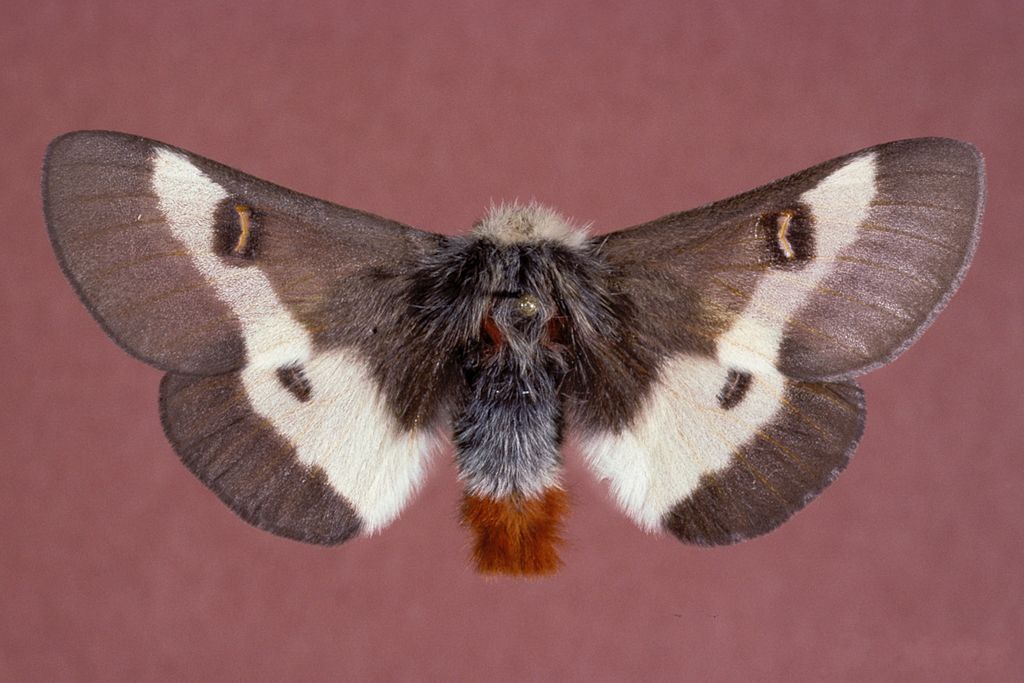
This hairy-looking guy is a buck moth, and he clearly demonstrates another difference between moths and butterflies. Moths are generally stout and fuzzy, while butterflies are slender and smooth. The larvae of this  Ewok-looking moth have hollow spines, which are attached to a poison sac, and their sting can cause itching, burning and nausea. This moth is also a rebel. Unlike other moths, this guy prefers to fly during the daytime.

[image: wikipedia]


Another day-flying rebel moth is this brightly-colored urania leilus of South America.


[image: wikipedia]


But the biggest rebel of all has to be this Castniid moth of Australia and Indonesia. Not only are they day-fliers, but they have clubbed antennae and brightly-colored wings. (Half of 'em, anyway.)


[image: wikipedia]


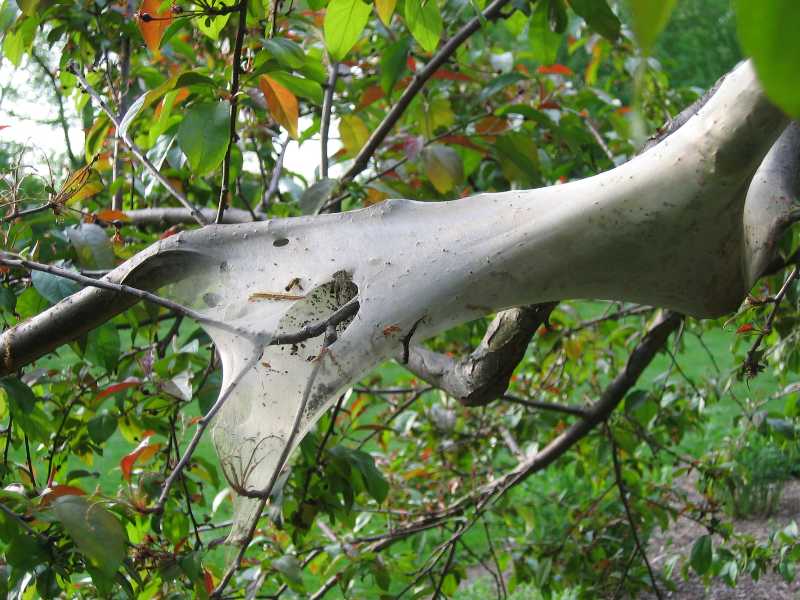
Recognize this? It's a tent caterpillar nest. These moths are more sociable than most, and build and share huge silk nests. Where I grew up in Maryland, they were very prevalent, with nests in almost every tree, and bazillions of the caterpillars lumbering all over the place on the ground. I used to kinda like them, until the boy down the street smashed several of them on top of my head. I never felt quite the same about them again...

The largest moth? That would be the Atlas moth, whose wingspan can be as great as twelve inches. The smallest? The appropriately named pygmy moth, which is a teeny 3/32 of an inch. Barely noticeable, right? Not so of this Atlas monster:


[image: wikipedia]


With wingspans measuring an average eleven inches, Birdwings are the largest butterflies. This chart shows males on the left and females on the right.

The smallest? Blues, which are between one quarter and one half inch in size. And, um... they're blue.


[image: wikipedia]


One of the coolest butterflies... and the queen of camouflage... has to be this dead leaf butterfly. Amazing, isn't it?


[image: wikipedia]


When its wings are open, it shows it true colors.


[image: wikipedia]
This is a gypsy moth larva. For a very brief while, our older son had one of them... as a pet. Larry the larva.


In the early seventies, my mother and aunt came down for a visit, and while Smarticus was at work, we went to Lake Lanier for the day. The place was absolutely swarming with an army of official-looking khaki-clad fellas, but we didn't bother them, and they didn't bother us. In the meantime, our son found the colorful larva and like most little boys, wanted to bring it back home. Well, (ahem) it turned out that those men were on the look-out for gypsy moth larvae... so they could kill them, because the little boogers are extremely destructive. And we, um, brought one home with us. Let's just say the holes we punched in the jar lid had verrrry sharp edges, and Smarticus, being the friendly fellow he is, yelled "Helloooooo, Larry!" to the larva quite often... while, um, shaking the jar vigorously. (What? The rude little guy refused to answer!) And that... was that...for the dearly departed hairy Larry.

I can't resist sharing this video with you. It's another one of the giant Atlas moth. I mean, what kinda person would let a moth do this...?


                                     I would NEVER! But a butterfly? That's a different story...


I'm flitting off to spend some time with our grandchildren, so I won't be responding to your comments right away. Trust me, I will not let our kiddos capture any larvae in a jar.

                           Until next time, take care of yourselves. And each other.


Friday, June 2, 2017

Lessons from a Butterfly

Thought for the day: What a caterpillar calls the end of the world the master calls a butterfly. [Richard Bach]

[image by Leonard Chapel]
Most of us have seen monarch butterflies, but have you ever seen a monarch caterpillar? Its colors are so pretty, it's easy to imagine what a big beautiful butterfly he'll be one day, isn't it?

If he's lucky.

Not all butterflies are.


Time for a story...

Once upon a time, a very well-meaning lady with a loving heart was taking a hike through the woods, when she came upon a butterfly cocoon that was about to open.

"How lovely!" she exclaimed, clapping her hands in delight. "I'll stay and watch."

Breathlessly, she watched as a tiny hole finally appeared in the cocoon, and then for hours, she continued to watch as the butterfly struggled to force its body through that tiny hole.


Then, as though it were too exhausted to continue any longer, the butterfly stopped struggling and just sat in its cocoon, motionless.

"Oh, no," the well-meaning lady with the kind heart said. "I've got to help him!"

So she pulled out her pocketknife and ever-so-carefully enlarged the opening in the cocoon.


Thanks to her help, the exhausted butterfly easily emerged, but its body was small and withered, and its wings were shriveled.


The well-meaning lady with the kind heart continued to watch the butterfly, anxiously waiting for its big beautiful wings to flutter open and expand.

But they never did.

The butterfly lived out his life with a withered body and shriveled wings. Its wings never grew strong enough to support the weight of his body... and he never flew.


See, the struggle to emerge from a cocoon is necessary for a butterfly's development. Squeezing through a tiny opening forces the fluid out of its body and into its wings, making them strong and ready for flight.

Without completing that struggle, the butterfly can't fly.


      You see what I'm getting at? The moral of the story? The lessons to be learned?


Two things. First, before we impose our well-meaning help on another creature or person, we should know that our help is genuinely needed and/or wanted. Sometimes, the kindest thing... and the hardest thing...we can do is to stand by and offer support, while our friend overcomes his challenges on his own. And second, like butterflies, there are times we, too, have to struggle through some really tight spots in our lives. But don't give up, and don't lose heart, because determination in the face of obstacles strengthens us, and conquering those obstacles allows us to fly.


It's still a good thing to offer a lift or welcome resting place to butterflies and our other friends when they need it...


and to enjoy their visits and companionship... even if they do occasionally poop on your head.


In the end, we all... both butterflies and people... want to live up to our potential.

We want to fulfill our destinies... and we want to soar as high as our wings... and our dreams... can take us.


                          Until next time, take care of yourselves. And each other.


Friday, March 13, 2015

Know News... or No News?

Thought for the day: To look at the paper is to raise a seashell to one's ear and to be overwhelmed by the roar of humanity.  [Alain de Botton]

[wikipedia]
Okay, I'll admit it. I'm a newspaper junkie. Matter of fact, it still bugs me a teensy bit that I had the darned measles when my elementary school class took a field trip to the massive Baltimore News Post building. While my classmates were watching and hearing that huge press in action, I was stuck at home, scratching like a monkey with fleas. Oh well. The newspaper folks made a nifty metal press of each of our names, and I still have that memento, anyway.

[morguefile]


Ever since I was a young girl, I've devoured newspapers, and somewhere along the line, I developed the habit of tearing out articles that pique my curiosity, something I continue to do to this day. In recent years, journalism has changed, almost to the point where I'm beginning to fear Mark Twain was right when he said, If you don't read the newspaper, you're uninformed. If you read the newspaper, you're misinformed. 

Still, it's a lifelong habit I'm not likely to change. Today, I'm gonna share four stories I've saved from the past year or so.


For most folks, no news is good news. For the press, good news is not news.  [Gloria Borger]

Not true. Some news is good. Or at least, it's entertaining...

[morguefile]
** Eating with a degree of dignity can be very difficult for people who suffer with severe tremors. The constant shaking makes self-feeding a challenge at home, and pretty much out of the question in public.

Until now.

Google... yes, THAT Google!... has developed a special spoon that can steady those tremors. Sounds like science fiction, doesn't it? But it isn't; it's technology at its finest. The technology used in Liftware spoons senses how a hand is shaking, and makes instant adjustments to keep the spoon balanced. Shaking is reduced by an amazing 76%.
[morguefile]

** Amsterdam has a rather unusual government-sponsored program aimed at alcoholics. The logic behind this program is to offer alcoholics a better option than sitting on a park bench drinking all day, so they're offered a job cleaning litter from the streets. And paid... in beer. Typically, their mornings start with two beers... then two more at lunchtime, and another one or two later in the day. Oh, they don't just get paid in booze. They also get half a packet of rolling tobacco, free lunch, and ten euros a day. (About $13.50) The program is so popular, there's a long waiting list of chronic alcoholics who are eager to join the beer-fueled cleaning teams. So what do you think? Is this is good idea?

[morguefile]
** In God we trust. Those words are proudly printed on our paper currency, and on some of our state's license tags and/or flags. So it should come as no surprise that the Pinellas County Sheriff's Office in Florida decided to have those words printed on their new carpet. A fine carpet it was, too. Forest green, with the sheriff's yellow badge on it, along with those sacred words. 'Cept for one thing. After being in place for a couple months, a sharp-eyed deputy (or at least sharper-eyed than the rest of the folks around there) noticed a slight misspelling. The rug said In Dog we trust. (Oops!)

[morguefile]


** Isn't the monarch butterfly gorgeous? Its wings remind me of delicate stained glass. Did you know their population has experienced an astounding 90% decline in recent years? Although the U.S. Fish and Wildlife Service hasn't placed it on the endangered species list yet, the federal government has pledged 3.2 million dollars in an attempt to save this iconic North American beauty.  Some of the money will be spent on the restoration of natural habitats, including more than 750 schoolyard habitats and pollinator, and gardens, and the rest will go into a conservation fund that will provide grants to farmers and other landowners to conserve additional habitat.

Yeah, I'm pretty enamored with butterflies, especially since this one paused to poop on my head at the butterfly festival we attended last year. (Not really... he just stopped by to say hello.) 

But here's the thing. I learned at the butterfly festival there's something each of us in North America can do to help these beautiful creatures right in our own back yards. (Or front yards; I'm not picky.) Plant milkweed. Really. Monarchs lay their eggs on milkweed plants, which provide the nourishment developing larvae need. Because of development, and the widespread use of pesticides, milkweeds and other nectar sources are becoming increasingly scarce throughout North America. Less milkweed equals less monarchs. The simple act of planting milkweed can transform your yard into your very own monarch habitat and way station. (A fantastic project for kids and grandkids!) You can even get it certified, although I must admit, there's no guarantee that an official sign beside your garden will draw a larger number of butterflies. (shhhh... they can't READ!) However, it MIGHT inspire others to follow suit. Wanta make a difference? Here's your chance. For more information, please see this site and later, how about posting a picture of yourself with a monarch butterfly sitting atop YOUR head? (If they DO poop, it's so small, you'll hardly notice... and besides, it probably smells like flowers... )

Time to flutter off! The eye doctor awaits. Have a super weekend, y'all.

How about some other newspaper stuff to keep you entertained while I'm gone?


                                      Until next time, take care of yourselves. And each other.

P.S. Are any of you having a problem posting Youtube videos? Up until a few weeks ago, I could do it easy-peasy, but now? Not. The video will embed on the draft, but NOT on the preview or published post. It just POOF! disappears. Any ideas? Thanks. Ciao!

Friday, September 12, 2014

When Butterflies Flutter By

Thought for the day:  Why didn't Noah swat those two mosquitoes when he had the chance?


[courtesy of Perfectly Timed Photos]


I can't be too bad; mosquitoes certainly still find me attractive. Matter of fact, all bugs, both the creepy-crawlies and the airborne, have always had an impressive talent for picking me out of a crowd.

[Morguefile]


Without a doubt, though, mosquitoes have gotta be my biggest fans. If I'm outside with ten other people, only one of us will be attacked by a swarm of those blood-thirsty little... darlings. Me. Doesn't matter worth a flip if I'm wearing repellent, either, because the skeeters around here consider DEET to be nothing more than a finishing sauce.

I'm telling ya, when I go outside in the morning to get the paper, they're hunkered down waiting for me like a squadron of fighter jets with their engines running, and they immediately swoop after me like a bunch of hungry teenagers at the dinner table. I have found one way to get the upper hand... actually, upper foot... with them, though. When I pick tomatoes in the afternoon, the greedy little suckers gorge on my blood until they get so bloated, they can't even fly anymore. They just hover about six inches off the ground,  groaning and holding their bellies. So I... step on 'em. (While singing, Hit the road, Jack, and don't you come back no more, no more, no more...)


[credit: Muhammed Mahdi Karim]
Bees like to have their way with me, too. I've gotten lots of bee stings over the years, but the worst were the ones on my upper lip and between my eyes. The resultant swelling made me look like the cover picture for a monster magazine, which my big brother was only too happy to point out. (In his defense, we were young. If it happened now, I'm sure he'd try to stifle his guffaws.)

But at least bees serve a purpose, unlike those pesky mosquitoes. (Unless you call spreading disease a divine calling.) Isn't that picture of the bee absolutely phenomenal? Would you believe that little guy is carrying pollen?! What a shot!

[Morguefile]

Oh, look... that butterfly and bee are sharing the same bloom. Hmmm, could they be discussing.... me?

Perhaps the bee is agreeing not to sting me this time...?


Oh my goodness, just look at all the butterflies!

My thoughts are like butterflies. They are beautiful, but they fly away. [anonymous]


Oh, and lookie there. I think that one's a swallowtail.

May the wings of the butterfly kiss the sun and find your shoulder to rest upon, to bring you luck, happiness and riches, today, tomorrow, and beyond. [Irish blessing]

A new friend!

Happiness is a butterfly, which when pursued, is always just beyond your grasp, but which, if you will sit down quietly, may alight upon you. [Nathaniel Hawthorne]


This monarch is a real beauty, isn't it? And it posed so nicely for me...


Before it (gasp!) came closer...

Know what? That made up for every mosquito, bee, fire ant and spider who's ever been attracted to me.

What can I say? If you think about it, it's a lot like life. We have to put up with some painful bites and stings over the years, but beautiful blessings also have a delightful way of fluttering by and oh-so-gently... pooping on your head.


Wanta hear whose favorite old broad comment won a copy of Old Broads Waxing Poetic? Okay. (Insert drum roll here.) It's a pleasure to announce that (ta-DA!)  Stephen T. McCarthy takes the prize this time around with his expression of unabashed love and admiration for his mother. (sniff) Ya gotta love a guy who loves his ma. (If you'd like to read his comment, it's in the previous post.)

This old broad is gonna be flitting around here and there being a social butterfly for the next four days or so, but if all goes well, I'll be back to responding to your comments on Tuesday.

                                       Until next time, take care of yourselves. And each other.