Showing posts with label women. Show all posts

Friday, March 15, 2019

In Praise of Kick-Ass Women

Thought for the day:  For most of history, Anonymous was a woman.  [Virginia Woolf]

[image courtesy of Wikipedia]

Know what last Friday was...? Give up?

It was International Women's Day. (Yeah... really!) And doggone it, I'm still waiting for my darned cake...

The first International Women's Day was in 1910, but because its roots were based in socialism, for many years, only places like Russia and Eastern Europe paid any attention to it. That is, until 1977, when the U.N. finally climbed aboard and officially proclaimed March 8 to thereafter be known as International Women's Day.

Anyhow, the whole month has now been designated to the recognition of women, whose contributions to society have largely gone unnoticed, and I thought I should write something about at least one of those rather amazing unsung women from history before the month comes to an end. This post is actually an updated version of one from six years ago, so some of you may remember parts of it, but I believe this lady's story merits a re-telling, because for whatever reason, her story still remains largely untold.


A woman is like a teabag: you can't tell how strong she is until you put her in hot water.  [Eleanor Roosevelt]

Oh well, still no cake to go with my tea. (For now.) Nonetheless, it's my pleasure to forge ahead and tell you a little something about a little-known kick-ass American woman who deserves a spot in our history books.

Okay, quick: Who was the first woman in American history to run for national office?

[image courtesy of Wikipedia]

If you said 1984 V.P. candidate Geraldine Ferraro...

you would be...

 ( Ding-Ding-Ding!) wrong.

She was the first to be nominated by a major party, but would you believe the first woman, who actually ran for President, did so fifty years before women were even granted the right to vote?

I kid you not. That lady had some serious kinda chutzpah.

[image courtesy of Wikipedia]
Yep, her name was Victoria Woodhull, and in 1872, the Equal Rights Party nominated her as its presidential candidate. Equal rights is exactly what she believed in, too... for women, for blacks, and for the working class.A year earlier, she became the first woman in history to appear before the House Judiciary Committee, where she delivered an impassioned and articulate argument for women's suffrage. And she had other radical outside-the-box ideas, too, such as an eight-hour workday, graduated income tax, social welfare programs, and profit-sharing. Not exactly mainstream thinking for her day.

In 1870, before she ran for office, she was the first woman to open a Wall Street brokerage firm. Made a boatload of money, too, some of which she used to become the first woman to found a weekly newspaper. The purpose of the paper was to support her run for office, and its primary interest was feminism. During its six years of publication, the paper covered such taboo topics as sex education, free love, women's suffrage, short skirts, spiritualism, vegetarianism, and licensed prostitution.

I used to be Snow White, and then I drifted. [Mae West]

[image courtesy of Wikipedia]
Uh, yeah, I did say free love. Not an orgy-filled, spouse-swapping kind of free love, mind you, although by the way she was treated by many people of her time, you would've thought that's exactly what she was espousing. What she believed in was a woman's right to marry, divorce and bear children as she saw fit... without governmental interference.

At right is a Thomas Nast caricature of Woodhull, depicting her as Mrs. Satan. She's holding a sign that says, Be saved by FREE LOVE, and behind her is a woman, laden with children and a drunken husband. In the caption, the woman tells Mrs. Satan, I'd rather travel the hardest path of matrimony than follow your footsteps. 

See? Not even the women of Woodhull's day supported her ideas. Not that it mattered... they couldn't vote.

Some people think having large breasts makes a woman stupid. Actually, it's quite the opposite: a woman having large breasts makes men stupid.  [Rita Ruder]

[image courtesy of Wikipedia]
Oh, there's a lot more to the story of Victoria Woodhull... like her dabbling in magnetic healing and spiritualism; her friendship with Cornelius Vanderbilt; and why she was thrown into jail two days before the 1872 election... on obscenity charges.

But I said I was only gonna tell you little something about Ms. Woodhull, so I won't elaborate. Suffice it to say, she didn't receive a single electoral vote. Following the election, she said, The truth is that I am too many years ahead of this age and the exalted views and objects of humanitarianism can scarcely be grasped as yet by the unenlightened mind of the average man. 

Okay, so I never said she was humble. But she was right. Many of the reforms she campaigned for, considered extreme and controversial in her time, later came to pass. By the way, know who her running mate was? Frederick Douglass... the first black man nominated for national office.

How do you know if it's time to wash the dishes and clean your house? Look inside your pants. If you see a penis in there, it's not time.  [Jo Brand]

Well, it's not time for me to wash the dishes and clean house, either. Not yet. It's time to bake myself a damned cake. I am woman; hear me roar!


A woman should always know her place. Yep, by golly, a woman's place is in the House... and the Senate... and maybe someday...  the White House.

So in celebration, let us raise a glass (or cuppa) to all those wonderful women worldwide, both known and unknown, who spent (and continue to spend) their lives striving to make this world a better place, and who exemplify these words by Maya Angelou: ... you shouldn't go through life with a catcher's mitt on both hands. You need to be able to throw something back.

[image courtesy of Wikipedia]

I always wanted to be somebody, but now I realize I should have been more specific.  [Lily Tomlin]

With deepest apologies to all of you good poets out there, here is my humble Haiku salute to the way-ahead-of-her-time Victoria Woodhull:

                                         Brazen seeds of thought,
                                         Sown now, bereft of sunshine,
                                         Shall bloom in due time.

                             Until next time, take care of yourselves. And each other.


Friday, March 10, 2017

Intrepid Flyers

Thought for the day:  Endurance is the price tag of accomplishment.


Wouldn't it be cool to fly like a bird? To soar and swoop and make some lazy circles in the sky... it's a dreamy thought, isn't it? But not a new one. Man has always been enthralled with the idea of flight.

Today, we're going to talk about some very unusual flyers... the first from the bird kingdom, and the next from the human ranks. One thing these groups have in common is determination. Determination and endurance. (Okay, two things.)

                                                                 First, the bird.

[source:Henri Weimerskirch, CNRS, France]
It practically takes an act of Congress to get some children out of bed at times, but not so for juvenile frigate birds. No sirree, and it's none of that lazy circles in the sky stuff for them, either. It isn't at all unusual for a young frigate bird to take off from his cozy nest and fly non-stop for the next 185 days straight... covering as much as 34,000 miles.

[source: Aurelian Prudor, CNRS, France]


These amazing birds, with their lovely forked tails and wingspans of up to seven and a half feet, (2.3 meters) fly an average of 255 miles per day... and can do it for months on end.

They accomplish this by making brilliant use of the wind currents, and they can ascend to 2000 feet and then drop back down to sea level with only a single flap of their massive wings.
[wikipedia]


Another interesting fact about these birds is, even though they're classified as seabirds... they can't get in the water. Why? Their feathers aren't waterproof. If they were to dive into the water or even land on its surface, they'd get waterlogged, and wouldn't be able to fly again. So if they choose to eat during their long journeys, they have to swoop down and grab small critters from near the water's surface.  According to scientist Henri Weimerskirch, of France's Center for Scientific Research, (CNRS) who tracked 80 of these birds for two years and learned about their remarkable ability to master air currents, "There is no other bird species like them."  (No wonder this male's chest is all puffed out!)


The human flyers were part of a remarkable group, too, and since it's only a couple days after International Women's Day, it's rather fitting that they were also... women.

[credit: Sovfoto/ UIG- 1944]


Meet the Nightwitches, aviators of Russia's all-female 5880th Night Bomber Regiment. These brave women, ages 17 to 26, some of whom had never even seen an airplane before they joined the regiment, played a vital role in World War II, and struck terror in the hearts of their enemies.


[wikipedia]


These women flew in Polikarpov PO-2s, re-purposed biplanes from the 1920s, which were constructed of wood and canvas, and had been used mainly as crop-dusters prior to the war. These planes were slow, obsolete, and contained no radios or radar, so rudimentary navigation hinged on a stop watch and a map.

[[credit: Quality Time]


So what was so terrifying about these women, and how did they get the nickname Nightwitches? That's the English translation of the name bestowed upon them by German soldiers, who called them Nachtexen. (which, um, obviously means the same thing...) See, what these women did as they conducted their night missions was as they approached their targets, they shut off their engines. Then they'd glide down to drop the bombs, so the only sound accompanying their descent was the whoosh of their planes cutting through the air... which sounded like witches' brooms to the soldiers below.

[credit: The Image Works]


After dropping their bombs, the airplane engines then had to be re-started in mid-air, and if that meant a navigator had to climb out onto the wing to give the prop a spin, sobeit.

Because the planes were only capable of carrying two bombs at a time, each night's mission consisted of multiple flights ... as many as eighteen harrowing sorties in a single night. Weight limitations of these planes didn't just dictate the amount of armament they could carry, either. It also meant no parachutes.

At its largest, this battalion contained forty two-person crews, and in total, these gutsy gals carried out 30,000 missions, and dropped 23,000 bombs. At first, Russian male pilots thought these brave young women were a joke, but they soon learned to respect them for their courage, their ability, and their endurance.

[courtesy the Image Works]

Nadia Popova, who was sometimes referred to as Russia's Amelia Earhart, said, In winter, when you'd look out to see your target better, you got frostbite, our feet froze in our boots, but we carried on flying." 

After one mission, her airplane was riddled with forty-two bullet holes, and she was shot down a couple of other times. Still, she persevered and continued to serve as a Nightwitch commander. She passed away in 2013 at the age of 91, and she and her fellow witches will long be remembered as some of Russia's most intrepid flyers.

Determination is doing what needs to be done even when you don't feel like it. [author unknown]

Failure will never overtake me if my determination to succeed is strong enough. [Og Mandino]

Determination gives you the resolve to keep going in spite of the roadblocks that lay before you. [Denis Waitley]

Endurance is the price tag of achievement. [author unknown]

Each of us, in our own way, has the ability to fly. Maybe not across an ocean like a frigate bird, and maybe not in daring night missions in antiquated airplanes... but we can fly; we can succeed. Those birds don't back down when faced with the daunting task of flying for weeks and months on end; they just do it. Those women, many of whom had never even seen an airplane before, didn't say, "We can't do it;" they just did it. Like them, with determination, we, too, can overcome obstacles, and we, too, can fly. We can achieve, and we can make our dreams come true, so never settle for less. Remember, even the grandest oak tree started out as a little acorn that refused to give up. Surely we nuts can do the same.


                                  Until next time, take care of yourselves. And each other.

Friday, August 5, 2016

Who Says Women Can't Drive?

Thought for the day: The one thing that unites all human beings, regardless of  age, gender, religion, economic status, or ethnic background, is that, deep down inside, we all believe that we are above-average drivers. [Dave Barry]

Yeah, that's me sitting in the dragster. As you can tell, the car wasn't on the race track, or even on the street. It was parked on a backyard driveway.

And the engine wasn't running.

Come to think of it, that's about the only time Smarticus ever felt comfortable when I was sitting in the driver's seat. That, and the time I drove him home from the hospital while he was still feeling the effects of anesthesia. Okay, okay, okay... I'm not saying I  never earned his misgivings. It's possible that I may have been in a fender-bender or two when I was young and newly-licensed. Smarticus likes to say that when we sold it, there wasn't a single piece of straight metal on the tank of a station wagon I drove back then, but that's a slight exaggeration. The roof looked great.

But this post isn't gonna be about me, or about how our then-toddler son laughed hysterically when my hubby tried to teach me how to drive a stick shift around the parking lot of his workplace. I mean, maybe it WAS a bit of a carnival-like herky-jerky stop-and-go ride, but still, it was terribly rude of him to laugh, dontcha think? Between his laughing and Smarticus' yelling, is it any wonder I never got the hang of it? Anyhow, I'm not gonna write about that, or about my missing sense of direction, either. (I think when God was handing out that particular gene, I never made it to the line, because I got... lost.) So what if I like to take scenic routes?

Some beautiful paths can't be discovered without getting lost. [Erol Ozan]

Anyhow, so what am I gonna write about? Or I should say... who? I'm gonna write about an amazing woman that most of you probably never heard about before.  Her name was Alice Huyler Ramsey, and man oh man, could that woman drive! And find her way around.

[morguefile]
 I guess you could say it all kinda started with a frightened horse. In 1909, her husband John encountered a monstrous driving machine while he was on horseback near their home in Hackensack, New Jersey. His terrified horse took off running, and John started to worry about his wife's safety, should the same thing happen to her. So he bought her a car. A 1909 dark green 4-cylinder, 30 horsepower, Maxwell DA, a touring car with two bench seats, and a removable roof.


[National Automotive History Collection, Detroit Public Library]
She was a natural behind the wheel. In a day and age when driving was still a rarity, in her first summer alone, this 22-year old mother of two put 6000 miles on her new car. Then she took part in a 200-mile endurance race. Representatives of Maxwell were so impressed by her driving skills, they made her an offer she couldn't resist: an all-expenses paid trip to prove to the world that a Maxwell could take anyone... even a woman... all the way across America. To Maxwell, it may have been a publicity stunt, but to Alice, it was a challenge. Her husband agreed to let her go, but he didn't want her to do it alone. He wanted her to take some other women with her.

Good driving has nothing to do with sex. It's all above the collar. [Alice Huyler Ramsey]

[National Automotive History Collection, Detroit Public Library]
Talk about the original girl trip! Two older sisters-in-law and a friend joined her for this incredible 59-day trek across the country. Alice did all of the driving, and the others provided company, and helped as best as they could.


[National Automotive History Collection, Detroit Public Library]

Of the 3800 miles this intrepid foursome covered from Manhattan to San Francisco, only 152 of them were on paved roads.


[National Automotive History Collection, Detroit Public Library]
Which led to eleven flat tires. In addition to the dirty task of changing tires, Alice also cleaned the spark plugs numerous times, and fixed a broken brake pedal. .


[National Automotive History Collection, Detroit Public Library]


Because of all the unpaved roads, it should come as no surprise that Alice's Maxwell bumped over many muddy holes, and got stuck in quite a few of them. In Nebraska, a clever farmer's son used a horse to pull them out of one of those holes... for a fee. When the car bottomed out again a mile farther down the dirt road, he was waiting for them. He happily pulled them out again... for a higher fee, of course.

Since there weren't many decent roads in those days, road maps weren't terribly plentiful, either. They had some from AAA, but for the most part, they navigated by following the telephone poles. They figured the more wires they saw, the more likely it would lead them to a town. This method wasn't fool-proof, though; they had to backtrack on several occasions.


[wikipedia]


Although the ladies spent most nights in a hotel, few offered deluxe accommodations. They may have had sheets on the beds, but some of them also had bedbugs. One night, they had to sleep in the car.  (Yep, it was stuck in another hole.)

In Nevada, they were surrounded by a Native American hunting party on horseback, bows and arrows at the ready. Not to be outdone, in Wyoming, they were waylaid by an armed posse that was chasing a murderer.

[wikipedia]
When they arrived in San Francisco on August 7, 1909, they were met by a cheering crowd. (More women than men, I'll betcha!) Some newspaper articles, however, called the journey ridiculous, and beyond the capabilities of women drivers. 

Her response? The criticism, of course, merely whetted the appetites of those of us who were convinced that we could drive as well as most men... it's been done by men, and as long as they have been able to accomplish it, why shouldn't I?

This feisty woman, Alice Huyler Ramsey, was the first woman in history to drive coast-to-coast across the United States. (And only one man accomplished this feat prior to her: Dr. Horatio Nelson Jackson, in 1903) For Alice, this trip was only the first of many. Between 1909 and 1975, she drove across the country more than thirty more times. (She stopped counting.) In 1960, she was named the Woman Motorist of the Century by AAA, and in 1961, she wrote a book about her cross-country adventures: Veil, Duster, and Tire Iron. In 2000, she became the first woman inducted into the Automotive Hall of Fame.

What a gal, huh? Oh, by the way, her husband, who became a U.S. Congressman, never learned to drive.

                             Until next time, take care of yourselves. And each other.

Men may or may not be better drivers than women, but they seem to die more often trying to prove that they are. [Tom Vanderbilt]

I have an idea that the phrase 'weaker sex' was coined by some woman to disarm the man she was preparing to overwhelm. [Ogden Nash]


Friday, March 18, 2016

Mothers of Invention

Thought for the day:  To invent, you need a good imagination and a pile of junk. [Thomas Edison]

Thomas Edison is kinda the quintessential inventor, along with a long list of other men you can probably name. Well, Plato may have said Necessity is the mother of invention, but I'm here to tell you that women, who may or may not have been mothers, can and have come up with some pretty doggone amazing inventions, too... things you may have incorrectly assumed were the brain children of men.

The guy who invented the first wheel was an idiot. The guy who invented the other three, he was the genius. [Sid Caesar]

For example, men have been the undisputed leaders in the automotive industry, but it was a woman named Margaret Wilcox, who made riding in an automobile more cozy with her 1893 invention of the car heater. Thanks to her device, which blew air over the top of the hot engine to warm the tootsies of nineteenth century motorists, women no longer got cold feet when it came to taking a spin with their fellas. Alas, her other invention of the combined clothes and dishwasher didn't catch on, possibly because people weren't enthralled with the idea of their soiled undies sharing a basin with their dinner plates. (Picky, picky, picky.) Another innovation that greatly improved motor vehicles was Mary Anderson's 1903 invention of the windshield wiper. True, we no longer have to manipulate a lever by hand to sweep a rubber blade over the windshield, but her ideas cleared the way for motorized versions.

I don't think necessity is the mother of invention. Invention, in my opinion, arises directly from idleness, possibly also from laziness— to save oneself trouble. [Agatha Christie]

[wikimedia]
To save oneself trouble? Maybe, but what's wrong with creating labor-saving devices? Like the dishwasher, for example. It should come as no surprise that a woman invented that. I mean, really. It was probably much easier for Josephine Cochran to invent the machine in 1887 than it was to get her husband's keister out in the kitchen to lend her a hand. The story has it that she and her husband liked to throw dinner parties, and she was so angry to find her servants had chipped some of her fine china while washing it after one of those parties, she swore they would never handle it again. (Somehow, I don't believe they were terribly upset at the thought of shedding this chore, do you?) That resulted in her spending time with her hands plunged into hot soapy water, a task she disliked so much, she turned her attention toward inventing something that could solve her problem. When other ladies weren't interested in purchasing her amazing machine, (Why should they? That's why they had servants...) she marketed it to hotels and restaurants. Even created a company to keep up with demand, which later became part of Kitchen Aid.

[wikimedia]
A woman is also credited with inventing the first electrical refrigerator. Florence Parpart accomplished this wondrous feat in 1914, and I'm sure her inspired creation had nothing to do with the fact that her ice man may have cometh late one time too many.

If you've read any of the studies about how the opinion of men and women differs when it comes to a comfortable room temperature, you shouldn't be surprised a woman name Alice Parker, who was probably sick and tired of having to wear a sweater in her own house, came up with the idea for gas-powered central heating in 1919. Although her unit was never manufactured, her idea allowed for the use of natural gas to heat homes, leading to the systems still used today. I thought, perhaps, that a menopausal woman might have come up with the first air conditioning unit, but I was wrong. It was a guy named Willis Carrier. ( Inspired by his wife or mother's hot flashes, perhaps...?)

[photo credit: Dupont Corporation]
Let's consider a few inventions made by the fairer sex that addressed some safety concerns, shall we? In this picture is Stephanie Kwolek, the brilliant chemist who discovered kevlar in 1965... the five times stronger than steel material that is used to make bullet-proof vests. Then there's Anna Connelly, who invented the fire escape in 1887, a lifesaver for countless apartment-dwelling people all over the world. Just as important as a means of safe escape from a burning building, so too is the safe escape from a sinking ship. Maria Beasley provided that with her invention of a life raft in 1880. She also invented a foot warmer, a steam generator, an anti-derailment device for trains, and a machine that makes barrels. She bore no responsibility, however, for the idiots who chose to crawl inside of one of those nifty barrels to plunge over Niagara Falls.

[photo credit: Harvard school of design library]
Think solar panels are a recent innovation? Think again. Chemist Dr. Maria Telkes was experimenting with solar energy from 1939 until '53. In addition to her many other accomplishments, her successful and much-acclaimed Dover Sun House, built in 1949, was the first home built that employed her solar heating system. Telkes is on the left, and at right is Eleanor Raymond, the architect who worked with her to make the house a reality.


[wikipedia]

Anybody else remember working with room-sized computers? Yeah, we really have come a long way, baby. In the '40s, Dr. Grace Murray Hopper, who in addition to being a computer scientist, was also a rear admiral in the U.S. Navy, invented COBOL, the first user-friendly computer software for businesses. She is allegedly also the first person to use the word bug in referring to a computer system glitch... and with good reason. She literally found a live bug inside of her computer... to be specific, a moth... which was wreaking havoc with the system.

[wikipedia]

This is a rather romantic-looking portrait of Ada Lovelace, the only legitimate child of Lord Byron. She, too, was a writer, but she was also a mathematician. She worked with Charles Babbage on an early mechanical general-purpose computer called the Analytical Engine, and her notes revealed the first algorithm intended to be carried out by machine, making her the world's first known computer programmer. (circa 1842)

There are only 10 kinds of people in the world– those who understand binary, and those who don't. 


[wikipedia]


The Analytical Engine, which is currently housed in London's Science Museum.


[wikipedia ]


Old movie buffs may recognize the oh-so glamorous Hedy Lamarr from this 1940 photo of her from MGM. But she was far from being just a pretty face. During WWII, she devised a jam-proof radio guidance system for torpedoes. Based on spread spectrum frequency-hopping, this innovative technology paved the way for everything from WiFi to GPS.

Here's another invention you might be surprised to know came from a woman. Closed circuit TV. In the sixties, Marie Van Brittain Brown worked as a New York nurse, and often worked the night shift, leaving her home alone during the day in a neighborhood riddled with crime and a notoriously slow police response time. With her husband Albert, she devised a device in 1969 comprised of a movable camera that could peer through any of  four peepholes in the front door, and sent the images to a monitor in her bedroom. Not only could she move the camera to see who was at the door, she could communicate with them verbally, remotely unlock the door, and hit an alarm button, if need be.

[wikipedia]
Dr. Shirley Ann Jackson has been at the forefront of an impressive number of innovations in telecommunications technology. Things like portable fax machines, touchtone telephones, solar cells, fiber optic cables, and the technology behind caller ID and call-waiting. This nuclear physicist has done research with the Fermi National Accelerator Labs, was a visiting scientist at CERN, worked at Bell Laboratories, and taught at Rutgers University. She also chaired the Nuclear Regulation Commission, and has been the president of the Rensselaer Polytechnical Institute since 1999. (whew!)


[wikicommons]

This game board remind you of anything? It's The Landlord's Game, created by Elizabeth Magio in 1904 as a tool to teach about the injustices of unchecked capitalism. She was denied a patent when she first applied for it, on the basis that the game was too complicated. Didn't stop others from building on her idea to create their own versions of it... including Charles Darrow, who successfully sold his game to Parker Brothers as Monopoly in 1934, and allegedly made millions of dollars. As for Ms. Magio, the company later compensated her, too, to the tune of five hundred bucks.

Another gal who almost had her idea stolen is Margaret Knight, who invented a machine in 1871 that folded and glued paper to make square-bottomed bags. The cad who tried to steal her idea claimed that no woman could invent something so brilliant. Luckily for her, not only was she brilliant enough to invent the machine, she was also brilliant enough to be able to prove it. Not only was she the first woman to get a patent in the United States, she became the holder of 87 of them in her lifetime, including one for a safety device for cotton mills, which she invented at the age of twelve, and which is still used today. Yep, when it came to her smarts, she had it... in the bag.

Ninkasi, Sumerian goddess of brewing and beer [wikipedia]

Women are also credited with some rather fun creations, too. Like an ice cream maker! Nancy Johnson came up with that one in 1843, and thanks to her, we can all enjoy a gallon pint nice little dessert dish of ice cream whenever we'd like.

Okay, if you men aren't duly impressed with any of the items mentioned thus far, maybe this one will make you sit up and take notice. According to beer historians, (Who even knew there was such a thing?!) Mesopotamian women were the first to develop, sell, and drink... beer.

Without question, the greatest invention in the history of mankind is beer. Oh, I grant you that the wheel was also a fine invention, but the wheel does not go nearly as well with pizza.  [Dave Barry]


                                       Until next time, take care of yourselves. And each other.

Thanks to Mr. Whyatt for graciously granting permission to post his cartoons on my blog from time to time.

Friday, March 4, 2016

A Head of Her Time

Thought for the day:  Remember, Ginger Rogers did everything Fred Astaire did, but she did it backwards and in high heels. [Bob Thames]

[morguefile]

No, this isn't gonna be a post about dancing... or shoes. Coming up right around the bend, on March 8, is International Women's Day, so what better way to mark it than by writing about some remarkable women? I was going to do a post about some female inventors, but then I remembered the following post, A Woman's Place, which I published on March 8, three years ago. I decided it's well worth a second look, and the lady inventors can just jog in place until later this month. Before we go to ye oldie but goodie re-run, let's kick things off on the right toe-tapping foot, with a little Ginger and Fred, shall we?


Okay, now back to that re-run... about a lady who was both ahead... and a head... of her time.

****************************************

Thought for the day:  For most of history, Anonymous was a woman.  [Virginia Woolf]


Know what today is...? Give up?

It's International Women's Day. (Yeah... really!) [NOTE: Well, it was when this post first ran... now, it's four days away...]

The tradition started in 1910, but its roots were based in socialism, so for many years, only places like Russia and Eastern Europe paid any attention to it. That is, until 1977, when the U.N. finally climbed aboard, and officially proclaimed March 8 to thereafter be known as
International Women's Day.


So where's my damned cake?


A woman is like a teabag: you can't tell how strong she is until you put her in hot water.  [Eleanor Roosevelt]

Okay, no cake to go with my tea. (For now.) Nonetheless, I'll honor the day by telling you a little something about a little-known kick-ass American woman who deserves a spot in our history books.

Okay, quick: Who was the first woman in American history to run for national office?


If you said 1984 V.P. candidate Geraldine Ferraro...

you would be...

 ( Ding-Ding-Ding!) wrong.

She was the first to be nominated by a major party, but would you believe the first woman, who actually ran for President, did so fifty years before women were even granted the right to vote?

I kid you not. That lady had some serious kinda chutzpah.

Yep, her name was Victoria Woodhull, and in 1872, the Equal Rights Party nominated her as its presidential candidate. Equal rights is exactly what she believed in, too... for women, for blacks, and for the working class.A year earlier, she became the first woman in history to appear before the House Judiciary Committee, where she delivered an impassioned and articulate argument for women's suffrage. And she had other radical outside-the-box ideas, too, such as an eight-hour workday, graduated income tax, social welfare programs, and profit-sharing. Not exactly mainstream thinking for her day.

In 1870, before she ran for office, she was the first woman to open a Wall Street brokerage firm. Made a boatload of money, too, some of which she used to become the first woman to found a weekly newspaper. The purpose of the paper was to support her run for office, and its primary interest was feminism. During its six years of publication, the paper covered such taboo topics as sex education, free love, women's suffrage, short skirts, spiritualism, vegetarianism, and licensed prostitution.

I used to be Snow White, and then I drifted. [Mae West]

Uh, yeah, I did say free love. Not an orgy-filled, spouse-swapping kind of free love, mind you, although by the way she was treated by many people of her time, you would have thought that's exactly what she was espousing. What she believed in was a woman's right to marry, divorce and bear children as she saw fit... without governmental interference.

At right is a Thomas Nast caricature of Woodhull, depicting her as Mrs. Satan. She's holding a sign that says, Be saved by FREE LOVE, and behind her is a woman, laden with children and a drunken husband. In the caption, the woman tells Mrs. Satan, I'd rather travel the hardest path of matrimony than follow your footsteps. 

See? Not even the women of Woodhull's day supported her ideas. Not that it mattered... they couldn't vote.

Some people think having large breasts makes a woman stupid. Actually, it's quite the opposite: a woman having large breasts makes men stupid.  [Rita Ruder]

Oh, there's a lot more to the story of Victoria Woodhull... like her dabbling in magnetic healing and spiritualism; her friendship with Cornelius Vanderbilt; and why she was thrown into jail two days before the 1872 election... on obscenity charges.

But I said I was only gonna tell you little something about Ms. Woodhull, so suffice it to say, she didn't receive a single electoral vote. Following the election, she said, The truth is that I am too many years ahead of this age and the exalted views and objects of humanitarianism can scarcely be grasped as yet by the unenlightened mind of the average man. 

Okay, so I never said she was humble. But she was right. Many of the reforms she campaigned for, considered extreme and controversial in her time, later came to pass. By the way, know who her running mate was? Frederick Douglass... the first black man nominated for national office.

How do you know if it's time to wash the dishes and clean your house? Look inside your pants. If you see a penis in there, it's not time.  [Jo Brand]

Well, it's not time for me to wash the dishes and clean house, either. Not yet. It's time to bake myself a damned cake. I am woman; hear me roar!

A woman should always know her place. Yep, by golly, a woman's place is in the House... and the Senate... and maybe someday...  the White House.

So on this day, International Women's Day, let us raise a glass to all those wonderful women worldwide, both known and unknown, who spent (and continue to spend) their lives striving to make this world a better place, and who exemplify these words by Maya Angelou: ... you shouldn't go through life with a catcher's mitt on both hands. You need to be able to throw something back.


I always wanted to be somebody, but now I realize I should have been more specific.  [Lily Tomlin]

 Before we go, how about another short video? Again, it features Ginger Rogers, but this time... with Lucille Ball. It's bound to put a smile on your face and start the weekend off with a... real big kick.

       
                                         Until next time, take care of yourselves. And each other.
                                            (Hey, ladies... why not treat yourselves to a cake?)
                             

Friday, October 4, 2013

Mum's the Word

Thought for the day:  The secret to creativity is knowing how to hide your sources.  [Albert Einstein]

Secrets? Yes! Workers who followed orders without knowing what they were doing or why they were doing it? Again, yes, yes, yes! Because absolute secrecy was absolutely essential for the success of a secret project conducted in a secret little town that didn't even appear on maps until after WWII had ended.

I'm talking about the Manhattan Project, and a unique town in Tennessee called Oak Ridge.


I'm talking about the creation of the atom bomb.


While visiting friends in Tennessee over Labor Day weekend, we visited the American Museum of Science and Energy in Oak Ridge... the ideal place to learn more about this little town's role in the Manhattan Project.

Before I take you inside, (so to speak) I have to tell on myself. And Kati. See this parabolic dish? It sits outside the museum. Actually, two of them sit outside the museum, facing each other, and separated by a good distance. The point is to whisper into one... and be heard at the other. Cool, huh? Yeah. Well, I must confess, Kati and I stood in front of this one dish... both of us... taking turns whispering into it. Our husbands, meanwhile, were all but rolling on the ground, convulsed with laughter. Yeah, I know. We get no respect. (It was pretty dumb of us, though... musta been something in that wine we drank the night before...)

Okay, ready to go inside now?

This picture depicts the genesis of the Manhattan Project. Albert Einstein and Leo Szilard wrote a letter to President Franklin Roosevelt, expressing their concerns about the possibility of Germany working to create an atomic bomb. Einstein urged the U.S. to achieve this goal before the Germans did.


                                                              The government agreed.

In September, 1942, the Corps of Engineers was authorized to acquire 56,000 acres of land in Tennessee, and to spend a total of 3.5 million dollars to do so. Why Tennessee? Because of sparse population, acquisition of land would be affordable. The area was also accessible by both road and rail, and most important, the TVA assured the government it could supply the necessary electrical power.

Approximately 1000 families were displaced, and they were notified by letters, such as the one shown in the picture. They were given no choice, and little time to vacate the premises. In the end, a total of 60,000 acres were acquired, at a total cost of 2.6 millions dollars, or about $47 per acre.

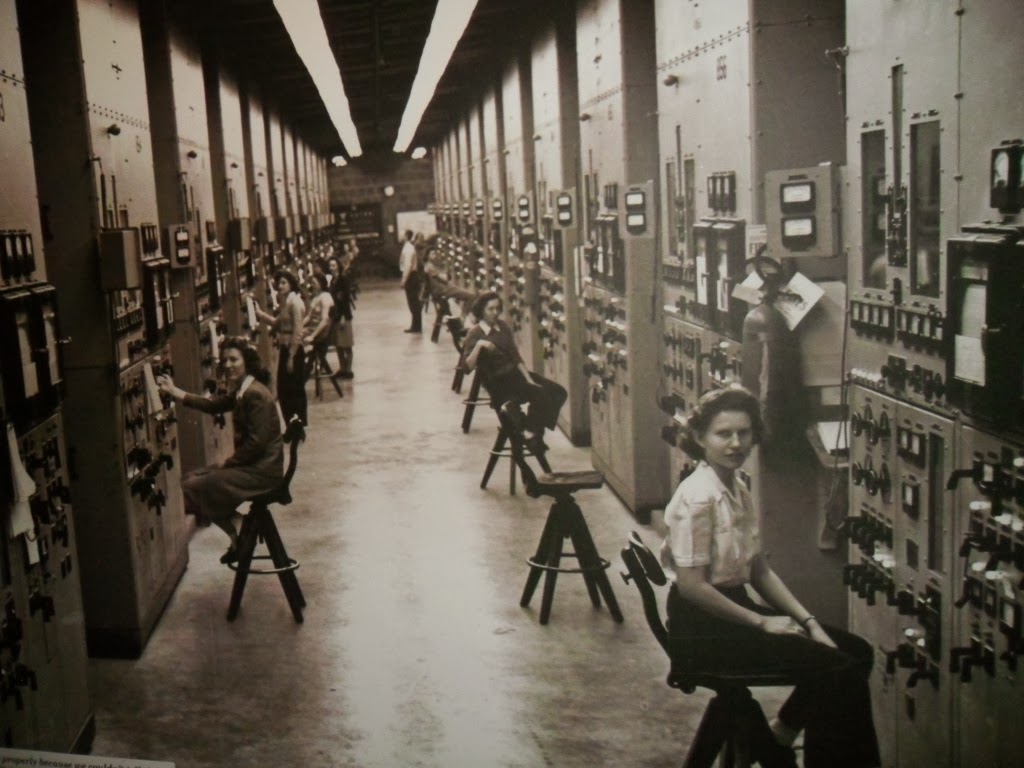
By March, 1943, all pre-existing structures had been demolished, checkpoints had been erected, and the entire area surrounded by fences topped with barbed wire. Within a matter of months, the area became Tennessee's fifth largest city, and at the height of construction, a house was built every thirty minutes. Housing included trailers, dormitories, hutments, and single-family dwellings called cemestos. Three window-less manufacturing plants of unprecedented size were built, as well as schools, businesses, community centers, medical facilities, and shopping centers. It was, in essence, a brand new city, built from the ground up, and at breakneck speed. A city shrouded in sworn secrecy.

When workers were asked for suggestions to name their city, fanciful names like Valhalla and Shangri-La were passed over in favor of Oak Ridge, after a nearby hill. However, the city's name only existed within its fences until after the war's end. Outsiders referred to it as Clinton Engineering Works.

Residential plans were originally designed to accommodate 13,000, but by 1945, Oak Ridge's population peaked at 75,000. Another 40,000 commuted in from surrounding communities to work in the plants. The town-within-a-compound bustled with soldiers and civilians, men, women, and children... all protected by barbed wire, roadblocks and armed guards.

According to Jay Searcy, who lived in Oak Ridge as a child, Nobody, nobody was allowed to talk about what he was doing. There was a war on. The enemy was listening. 

And not just the enemy. Approximately one in four workers was a government informant, and all workers were subjected to periodic lie-detector tests.


Then again, if the truth be known, very few people had any idea what they were doing.

We couldn't train them properly because we couldn't tell them what they were doing... We'd have to say, "On that gauge, when that needle turns to the right, you turn this knob to the left." But we couldn't tell them why.  L.W. Anderson, Union Carbide engineer

We cannot tell you what you are going to do, but we can tell you how to do it and we can only tell you that if our enemies achieve what we are trying to do before we do, God help us!  Gladys Owens, who worked with an electromagnetic separating machine known as a calutron. Unbeknownst to her at the time, she was separating uranium atoms.

The three Oak Ridge plants were known as Y-12, K-25, and X-10.  Because of a shortage of copper, almost 15,000 tons of silver were borrowed from the U.S. Treasury to be used as electrical conductors for the electromagnetic coils in the calutrons located in Y-12. (Believe it or not, ALL of this silver was returned to the treasury after the war.) K-25 used another more economical means to separate uranium, and X-10 contained a graphite-moderated nuclear reactor.


Alcohol was strictly forbidden in Oak Ridge, but what can I say? Where there's a will, there's a way. I've seen accounts of liquor being smuggled in past checkpoints inside of dirty diapers, and under women's dresses, clasped between their legs.


Dubbed the Trinity test, the first nuclear device was detonated in July, 1945.

Oak Ridge workers didn't realize what a monumental role they'd played until the atom bombs known as Fat Man and Little Boy were dropped on Japan the following month.


Peace cannot be kept by force; it can only be achieved by understanding. [Albert Einstein]

There was so much more to see at this museum, too much to cover in a simple blogpost. Photographs of children playing in a schoolyard, of Girl Scouts laughing, of people dancing and having fun... while living within an enclosed compound with a nuclear reactor and radioactive materials struck me as particularly surreal. But this, this was a page in our history. A fascinating page, where an entire city was built in less time than it takes to build a house nowadays. A secret city. A city where things like Teflon and HEPA filters were used for the first time. A city where the atom bomb was born.

                               Until next time, take care of yourselves. And each other.