Showing posts with label museums. Show all posts

Friday, June 10, 2016

As Years Go By

Thought for the day:  Time can be spent, but it can't be bought, so we've gotta spend it wisely. (It isn't always on our side...)


Last Saturday was our high school reunion, but Smarticus and I didn't spend all day driving to Maryland so we could attend. It wasn't our hundredth, but in human terms, it was a pretty big milestone. Fifty. (gulp) Fifty. (Maybe we'll attend our hundredth?)

To celebrate that rather auspicious half-century mark, I offer you the following poem about reunions. (Author unknown.)

Every five years, as summertime nears,
An announcement arrives in the mail,
A reunion is planned; it'll be really grand;
Make plans to attend without fail.

I'll never forget the first time we met;
We tried so hard to impress.
We drove fancy cars, smoked big cigars,
And wore our most elegant dress.

It was quite an affair; the whole class was there.
It was held at a fancy hotel.
We wined, and we dined, and we acted refined,
And everyone thought it was swell.

The men all conversed about who had been first
To achieve great fortune and fame.
Meanwhile, their spouses described their fine houses
And how beautiful their children became.

The homecoming queen, who once had been lean,
Now weighed in at one-ninety-six.
The jocks who were there had all lost their hair,
And the cheerleaders could no longer do kicks.

No one had heard about the class nerd
Who'd guided a spacecraft to the moon;
Or poor little Jane, who's always been plain;
She married a shipping tycoon.

The boy we'd decreed 'most apt to succeed'
Was serving ten years in the pen,
While the one voted 'least' now was a priest;
Just shows you can be wrong now and then.

They awarded a prize to one of the guys
Who seemed to have aged the least..
Another was given to the grad who had driven
The farthest to attend the feast.


They took a class picture, a curious mixture
Of beehives, crew cuts and wide ties.
Tall, short, or skinny, the style was the mini;
You never saw so many thighs.

At our next get-together, no one cared whether
They impressed their classmates or not.
The mood was informal, a whole lot more normal;
By this time we'd all gone to pot.

It was held out-of-doors, at the lake shores;
We ate hamburgers, coleslaw, and beans.
Then most of us lay around in the shade,
In our comfortable T-shirts and jeans.

By the fiftieth year, it was abundantly clear,
We were definitely over the hill.
****

[Hmmmph! How can we be over the hill when we haven't even reached the top yet?]

So how did we spend our time in lieu of pretending a bunch of old farts and fartessas still look just like they did fifty years ago? We spent it with youngsters... four of our grandchildren. Rather than feeling old and (hmmmph) over the hill, we played and laughed and felt... young. Okay... young-ish. 


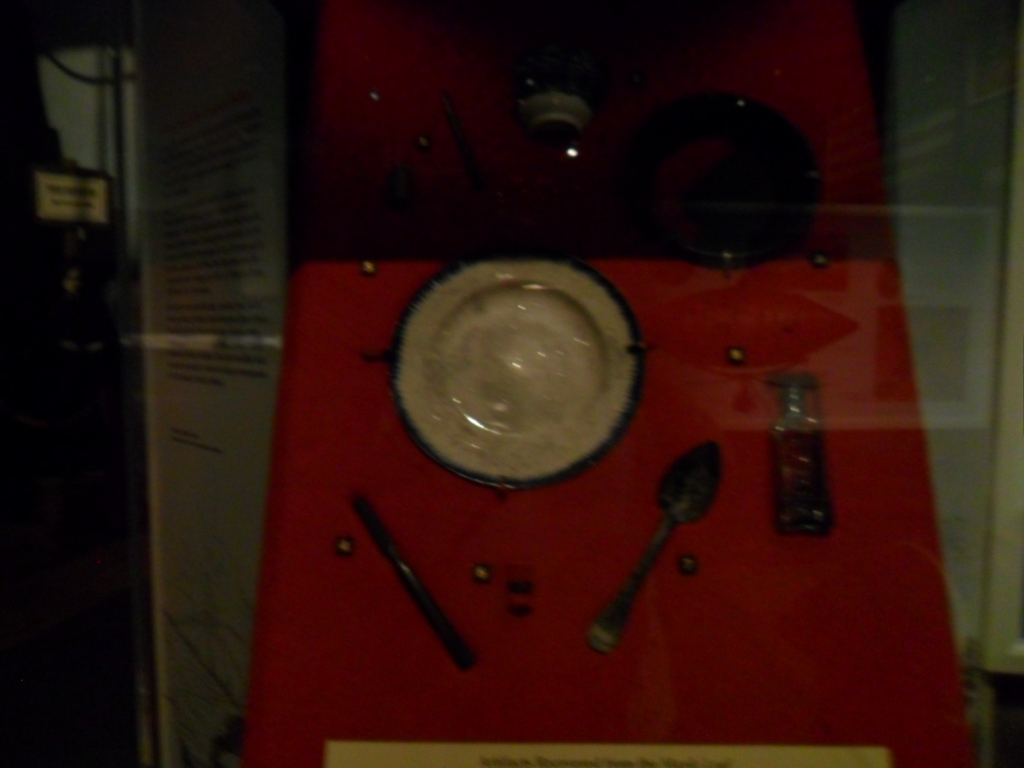
This summer, while our son and daughter-in-law are at work, their kiddos will be spending weekdays at karate camp, which is like a totally cool daycare, with karate lessons, and all kinds of other sports activities, field trips, and adventures. So while waiting for the family to get home, Smarticus and I visited the Civil War Naval Museum in Columbus. We'd been there before, but there was a new exhibit there that we hadn't seen: the Maple Leaf.


This paddle-wheeled steamer, which was built in Canada, (explains its name) and contracted by the U.S. Army during the Civil War, was sunk by a Confederate torpedo, and now rests at the bottom of the St. John's River, near Jacksonville, Florida. This shipwreck contains the largest collection of Civil War military and personal items in the country, and some of the recovered 130+ year-old items are currently on display at the museum in Columbus.


Plate and eating utensils.


Various recovered weapons and other items.

And of course, there was lots of other stuff to see at the museum, too...


Anybody know what this is?

It's the iron hull plate from the Civil War ironclad the Monitor. It was recovered in 1998, and weighs about 375 pounds. [This cool piece is currently on loan from the Mariners' Museum in Newport News, Virginia. Very nice of the Yankee aggressors to share, don't you think...?]


Okay, I don't want to screw up by making this post too long...


So I'm gonna drop anchor on talking about the museum, and move on to the kids.


Kymber looks surprised to have won her school's Student of the Year award, doesn't she?


L to R: Kymber, Devyn, Jaiden, and Aaron. Yeah, Aaron is the hambone. Also the one who's fascinated by weird facts, so you know I had fun telling and showing him about some of the disgusting things I know.


Now, thanks to their weird grandma, the kids know about lizards that squirt blood from their eyes, animals that break their own bones as a means of self-defense, beetles that squirt toxic liquid out of their butts,  a toxic bird called, appropriately enough, the patooie, and  they even saw pictures of dead cockroaches clad in tiny costumes. (Which used to be on display at a cockroach museum in Plano, Texas.)


Weird grandma? Maybe, but also a very happy one. No question about it. These kids conquered me and my heart a long time ago, and they still take it hostage every time we visit.


An hour with your grandchildren can make you feel young again. Anything longer than that, you start to age quickly. [Gene Perret]

But ya know what? It is totally worth it...  and one of my favorite ways to spend time.

How about you? Have you attended any of your class reunions? (We went to one... our thirtieth. There were a bunch of old people there...)

Do you, like me, ever look at other people your age and think they look much older than you do? If so, you'll appreciate this joke:

While sitting in my new dentist's waiting room, I noticed his diploma on the wall, and seeing his full name on it immediately brought to mind a tall, dark-haired, handsome boy with the same name, who'd been in my high school class nearly 50 years ago.

Could this dentist possibly be the boy I had a secret crush on in high school?

When I saw him, I quickly dismissed that possibility, because there was no way this gray-haired, balding man with the deeply wrinkled face could have been my classmate. He was way too old. Or was he?

After he examined my teeth, I asked him if he'd gone to Dundalk High School.

"Yes, I did!" he said with a smile.

"What year did you graduate?" I asked.

"In 1966," he said. "Why do you ask?"

"I was in your class!" I exclaimed.

He looked at me closely. Then, that ugly, wrinkled, old, fat, bald, gray, decrepit SOB had the audacity to ask, "What did you teach?"

****

Smarticus included the following in an email of funny stuff he sent me recently, and it puts some of the changes that have occurred in the past fifty years into perspective:

1966: Long hair
2016: Longing for hair

1966: KEG
2016: EKG

1966: Acid rock
2016: Acid reflux

1966: Moving to California because it's cool
2016: Moving to Arizona because it's warm

1966: Trying to look like Marlon Brando or Liz Taylor
2016: Trying NOT to look like Marlon Brando or Liz Taylor

1966: Seeds and stems
2016: Roughage

1966: Hoping for a BMW
2016: Hoping for a BM

1966: Going to a new, hip joint
2016: Receiving a new hip joint

1966: Rolling Stones
2016: Kidney stones

1966: Screw the system
2016: Upgrade the system

1966: Disco
2016: Costco

1966: Parents begging you to get your hair cut
2016: Children begging you to get their heads shaved

1966: Passing the driver's test
2016: Passing the vision test

1966: Whatever
2016: Depends

                                          ( For the record, I still like the Rolling Stones...)


                                     Until next time, take care of yourselves. And each other.


Friday, March 25, 2016

Digging for Treasure

Thought for the day:  Learning is a treasure that will follow its owner everywhere. [Chinese proverb]

There's all kinds of treasures in this world. Learning is definitely one of them, and one that I value highly, but when you were a kid, did you ever dig for buried treasure? Only things I ever found were pretty rocks and fat wiggly worms, which inevitably led to a different kind of quest... for fish.

Well how about if I tell you about someone else's tenacity in solving a mystery, and his successful search for buried treasure that led to a whole new world of learning?


The roots for this story were set before the Civil War, when steamboats were a vital part of America's economy, moving goods and people up and down her mighty rivers. This picture, sent to me by a friend, is a rendition of the steamship Arabia, who happens to be the star of our tale.

On September 5, 1856, this steamboat, on a voyage to deliver two hundred tons of cargo and one hundred and thirty passengers to sixteen different frontier towns, hit a submerged tree, ripped a hole in its hull, and in a matter of minutes, sank to the muddy bottom of the Missouri River. All human passengers survived; the sole fatality was a hapless mule.

The boat, like other steamboats that had met the same fate, was believed to be lost forever.


A river is more than an amenity; it is a treasure. [Oliver Wendell Holmes, Jr.]

[picture by David Hawley]
In this case, as the years went by, the treasured Missouri River wasn't the one hiding the Arabia. 

A local amateur treasure hunter named Bob Hawley was particularly intrigued by this missing steamboat and the mysterious cargo she held.  He knew the course of the river had shifted decidedly eastward over the years, and based on extensive research, he and his sons surmised in 1987 that the missing Arabia might be located in the middle of a Kansas City cornfield. The farmer graciously agreed to let them search and dig in his field... as long as they were done in time for spring planting. They were. After Hawley's metal detector pinged the boat's boilers, with the use of heavy equipment, he, his sons, and some other family members and friends, uncovered the missing boat four months later... forty-five feet down, and a half mile from the current riverbanks. In the course of their work, they removed twenty thousand gallons of water from the site.

The location of the boat isn't the most amazing part. The most amazing part is the condition of its contents. Buried under the mud for over 130 years, the goods were beautifully preserved, serving as a time capsule from the past, and showing us more about the needs of day-to-day living in frontier American than any history book alone could ever do. The remarkably preserved contents of this boat included clothing, tools, guns, food products, dishes, jewelry, wine, window glass, French perfume, lumber, a couple of prefab houses, a sawmill, and a case of cognac.

The past is a treasure chest filled with learning opportunities for our present and future, but only if we look inside. [Kevin Eikenberry]

Great idea! Shall we...?


This fine china was still preserved in its original yellow packing straw.


[wikipedia]


And not just a FEW dishes were found, either. LOTS of dishes were found, as you can see from this picture taken inside of the Steamboat Arabia museum in Kansas City.


Here's a glimpse at some of the recovered clothing.


You probably know that calico was a very popular fabric for making dresses back then, but most of the calico dresses didn't fare too well during their time spent in the mud. However, these porcelain buttons, printed to match the dresses they adorned, survived beautifully.


Many guns and knives were recovered.


Check out this spiffy-looking rubber shoe.


And a beaver-skin hat. Naturally waterproof!


The world's oldest pickles? Because there was no air reaching the foodstuffs, it was surmised that the jars of food were still edible. To test that theory, one brave escavator ate one of the pickles. According to him, the 130+ year old pickle still tasted fresh. 


These signs hang inside of the Steamboat Arabia museum in Kansas City. Alas, most of us will never have the opportunity to visit that museum in person, but rather than me posting more pictures, how about something much better?


                                                          A video taken inside the museum!


What an amazing story, and what an amazing place to visit... even if only vicariously.

                            Until next time, take care of yourselves. And each other.
   
Time to go digging for some more fun facts.

Friday, December 11, 2015

The Ways of a Warrior

Thought for the day:  Think lightly of yourself, and deeply of the world. [Miyamoto Musashi]

This time of year, most battles usually involve fighting for breathing space in the midst of shopping mall crowds, or trying to find a parking place within the same zip code as the store you want to enter, but I never enjoyed playing the role of shopping warrior, even on an uncrowded day. No, I prefer something a little more... exciting. More educational. More historic and romantic. I prefer another kind of warrior altogether: the Samurai.

So this past Saturday, given the choice of going shopping, writing out Christmas cards, or going to the Georgia Art Museum at the University of Georgia to see a samurai exhibit, which do you think I chose? Wasn't a hard choice at all...

The samurai were members of a powerful military caste in feudal Japan. They were provincial warriors in the beginning, and then rose to power in the 12th century under the Shogunate, the first military dictatorship, and dominated Japanese government and society until the end of the feudal system in 1868. However, the traditional samurai code of honor, discipline, and honor, known as bushido, was revived, and became the basic code of conduct for much of Japanese society.


Sheaths were things of beauty, and were uniquely designed for each warrior. The ornamentation on the sheath in the foreground depicts numerous insects.


Samurai philosophy:

I Choose
To live by choice, not by chance,
To be motivated, not manipulated,
To be useful, not used,
To make change, not excuses,
To excel, not compete.

I choose self-esteem, not self-pity,
I choose to listen to my inner voice, not the the random opinions of others.

I choose to do the things that you won't do so I can continue to do the things you can't.


The frontal ornament, or maedate, on this helmet, or kabuto, depicts a turtle-like creature called a minogame. He has fantastical tusks, pointed ears, a dragon-like snout, and a flowing tail of seaweed.


This frontal ornament, made of wood and lacquered in gold, depicts a shachihoto, a creature with the head of a tiger, body of a fish, and sharp spikes on its spine. Legend has it that when a shachihoto sees flames, it extinguishes them by either summoning rain or spraying water from its mouth. Many structures in Japan still have shachihoto ornaments on their roofs to protect them from fire.


 This helmet features a birdlike tengu demon. In some ancient Buddhist stories, the tengu personified evil in the form of passions and desires that hinder enlightenment. In other stories, it was a positive creature, fighting evil, guarding sacred mountains, and endowing humans with superhuman powers. I suspect the latter description is what inspired a warrior to feature a tengu on his kabuto.


This helmet, fashioned after a creature called an oni, was made with actual water buffalo horns, and features a mane made of horsehair. The oni are multi-faceted creatures that reside in Buddhist hell, but bring good fortune to humans. They can be malevolent tricksters or loyal protectors. Protectors is a good way to describe the Samurai.

By protecting others, you save yourself. If you only think of yourself, you'll only destroy yourself.  [from the 1954 movie Seven Samurai, upon which the later movie The Magnificent Seven, was based]

You may have seen helmets like this before. They seem to be worn by Samurai warriors, as depicted in most movies.

What does it mean to be Samurai? To devote yourself utterly to a set of moral principles. To seek a stillness of your mind. And to master the way of the sword.  [Algren- The Last Samurai]


Isn't this a cool-looking helmet? Too bad I didn't take any notes about it. (Sorry.)


Believe it or not, this picture shows a saddle and stirrups. Made of hardwood, and decorated in gold. Beautiful to look at, but I don't think that saddle (or any of the others in the museum) were particularly comfortable. They must have covered them with some thick blankets. I hope so, anyway. Not that comfort was a high priority for Samurai:

My life is simple, my food is plain, and my quarters are uncluttered. In all things, I have sought clarity. I face the troubles and problems of life and death willingly. Virtue, integrity, and courage are my priorities. I can be approached, but never pushed; befriended, but never coerced; killed, but never shamed. [Admiral Yi Sun-shin]

Here are a couple of short swords. There were many samurai weapons on display, and many of them were quite beautiful. One bow was reeeeeeeally long, and I can't imagine how one person could have possible wielded it. The arrows still looked lethally sharp, and quivers were magnificently decorated, and still brightly colored. The sheaths, hilts, and blades were genuine works of art. Most amazing to me, though, is how well all of these items have lasted through the centuries. Quite an experience to see in person, but in pictures? Not so much, so I won't bore you with any more of them. (You're welcome.)

To any fellow Georgian reading this, this exhibit will only be at the UGA museum until January third. If you have a chance to go see it, go for it! (Much more enjoyable than playing shopping warrior!)


In addition to this temporary exhibit, the museum contains many other permanent exhibits, as well, all worth seeing. This painted canvas screen especially captured my imagination. The curator told me it shows a scene inside of the Paris metro.

Oh, and did you know Samuel B.F. Morse was also an artist? I had no idea until I saw some one of his paintings at this museum. (And you don't even have to understand code to appreciate it.)


                                       Until next time, take care of yourselves. And each other.

Friday, August 7, 2015

On the Track to Adventure

Thought for the day:  Warning: the light at the end of the tunnel might be an oncoming train. 


[source: morguefile]
We saw plenty of trains last Saturday, but thank goodness, not a single one of them was coming at us through a tunnel. They were all sitting still, and on display at the Southeastern Railway Museum, which also happened to be hosting a bunch of antique trucks and tractors that day. AND we could climb up and walk through most of those old trains! Cool, huh? There's something romantic about the notion of traveling by train. Not the bazillion miles per hour bullet trains of today, but the old, slower-moving, steam-spewing trains with the fellow in the back waving a lantern from the caboose.

Since y'all couldn't join us that day, how about the next best thing... pictures? With, um , just a few words thrown in by me, of course...

There were quite a few steam locomotives there, but I won't bore you by showing you pictures of all of them. I'll just bore you by showing you a picture of one of them. This is the General II, which looks identical to the more famous General of Civil War fame, which is located at another museum in Kennesaw, Georgia.

The time will come when people will travel in stages moved by steam engine from one city to another, almost as fast as birds can fly, fifteen or twenty miles per hour...  [Oliver Evans, 1800] I wonder what this pioneer of steam engines would think about today's much-faster-than-a-bird speeds of travel.


There were also a number of steam-powered tractors there. Those things are HUGE!


This is an overview of one of the kitchens on a military train used from approximately the twenties until the forties.

What was that old saying from the Civil War? Something about the Army traveling on its stomach... 

And the other one... something about military food being the real spoils of war...?

Okay, so maybe the emphasis in cooking for the troops was more on quantity than quality. This 16-burner coal stove could sure handle the quantity part quite well. Can you imagine how hot it must have been in that train car when the cooking was going full steam ahead?


Yeah, these signs about humping always crack me up, too. (I wonder if there are also signs that say something like, Please hump here.)

In case you're wondering what it means to hump in railroad lingo, that's when an engine pushes a car, or block of cars, up a man-made hill... which is called a hump... so at the top, gravity can take over. The car(s) then go down the other side of the hill, and are easily shunted to the proper track and/or resting place.

Although that hump sign doesn't have anything to do with what consenting adults can do aboard a train, there have been a number of laws over the years aimed at regulating human behavior while riding the rails. For example, in Wisconsin, it was once illegal for people to kiss on a train, and in Seattle, Washington, if a woman dared to sit on a man's lap without placing a pillow between them, she would automatically face six months in the slammer. A bit harsh, don't you think? But this was even worse: in Alabama, putting salt on a train track was once punishable by death! Rhode Island was a bit more merciful; throwing pickle juice at a trolley was only a misdemeanor. In Chicago, Illinois, a law prohibited eating in a place that was on fire, but after considerable discussion, an amendment was added to that law in 1912, making it permissible to eat while in a steam train's dining car. Ready for my favorite? In Texas, an old law dictated that when two trains met at a railroad crossing, each had to come to a full stop, and neither could proceed until the other one had gone. (Huh?)

[source: morguefile]
Time for a joke:

Two somewhat inebriated fellas were having a very difficult time walking uphill on a railroad track.

Between huffs and puffs, the first one said, "This is the longest staircase I've ever seen."

The other replied, "The stairs aren't too bad, but I really hate these low banisters!"


I especially enjoyed going through some of the old Pullman cars. Tell you what, for their day, that must have seemed like luxurious travel. Some of the compartments were fairly spacious. The seats converted into beds, and some of the compartments even had a sink and commode. For family travel, some had an adjoining room with additional beds, usually bunked.


But as I gazed into these compartments with my imagination in overdrive, I couldn't help but remember a story I read some years back:

Mr. Pullman received a letter of complaint from a train passenger regarding a horrific infestation of bed bugs. In return, the passenger received a very nice letter of apology, thanking the man for letting them know about it, and assuring him that the matter would be taken care of immediately. Unfortunately, also in the envelope with that letter of apology was a hand-written note from Pullman to his secretary, advising her to send this SOB the bed bug letter. 


This is a 1915 Harvester, a 4-cylinder, 19 1/2 horsepower, Model F, one-ton truck. It is one of only ninety-nine trucks manufactured by the International Harvester Company in Chicago that year. Notice anything unusual about it? The radiator is located behind the engine.

Those of you who work crossword puzzles have probably come across the old Reo vehicles a time or two. Well, this is a 1912 Reo truck. Trucks like this were often referred to as High Wheelers because of those large wagon-like wheels. No wonder trucks of that vintage were called horseless carriages. 


This early fire truck makes it pretty obvious how much of a challenge it used to be to put out any large fires. Looking at the fire hoses and pump assembly, it was a very physically challenging job, as well.


Even if you're on the right track, you'll get run over if you just sit there.  [Will Rogers]


Okay, I don't know if this blog post is on the right track or not, but I'm not gonna just sit here. Time to go. That's right.

                                                             This is... THE END.

                                     Until next time, take care of yourselves. And each other.