Thought for the day: Justice is truth in action. [Benjamin Disraeli]
EXTRA! EXTRA! [National Archives]
A couple years ago, I wrote a two-part post, Art and the Human Spirit, about the internment of Japanese-American citizens during WWII.Those posts focused on human resilience, but today's post is going to approach the internments from a different angle. From the angle of justice.
[courtesy of Karen Korematsu and the Korematsu Institute]
Fred Korematsu was one of many Japanese-Americans living on the west coast at the beginning of World War II, when President Roosevelt issued Executive Order 9066, which authorized the internment of all people of Japanese descent into what was euphemistically called relocationcamps. On May 3, 1942, General DeWitt ordered 120,000 Japanese-Americans to report to Assembly Centers six days later as a prelude to their incarceration.
[National Archives]
As American citizens, many of whom were born and raised in the United States, these men, women, and children considered themselves to be red-white-and-blue American patriots. They hung banners and signs from their businesses declaring their allegiance, but it didn't matter, because they couldn't change the way they looked.
Tanforan Assembly Center [National Archives]
Twenty-two-year-old Fred Korematsu and his family were to be transported to Tanforan Assembly Center, where they'd be kept in converted horse stalls until assigned and relocated to camp. But Fred didn't believe the government had the constitutional right to imprison its own citizens without benefit of trial, hearing, or filing of charges. So he didn't go.
Waiting to be taken to camp. [National Archives]
He was nabbed on May 30 for looking like a Jap while standing on an Oakland street corner, and on September 8, was convicted in federal court for defying the order to report for relocation. He received five years' probation... but was sent immediately to Tanforan. Then, like so many others, he was put on a train to his assigned internment camp.
Topaz, Utah camp [National Archives]
Like the rest of his family, he was incarcerated in a desolate camp in Topaz, Utah. There, he lived in a horse stall lit by a single light bulb. He said conditions were worse there than in the jails.
Other residents of the camp avoided him, because they considered him to be a troublemaker, and thought his defiance was wrong and disrespectful. He continued to believe in their constitutional rights, and in the American justice system, and he was sure he would find justice in the courtroom.
Supreme Court building [Wikipedia]
The ACLU used his case to test the legality of the WWII incarcerations, and after losing several appeals, his case made its way to the Supreme Court in 1944. There, in a 6-3 ruling, it was determined that your ethnic affiliation can predispose you to disloyalty if you're an American of Japanese descent, and that compulsory exclusion, though constitutionally suspect, is justified during circumstances of emergency and peril. But Korematsu didn't give up He continued to pursue his plea of innocence. A special commission formed byPresident Carter concluded in 1982 that the internment of Japanese-American citizens was a grave injustice based on race prejudice, war hysteria, and failure of political leadership.That same year, Professor Peter Irons uncovered evidence that the government's lawyers had withheld important information during Korematsu's 1944 Supreme Court hearing. In 1983, the U.S. District of the Northern District of California overturned Korematsu's conviction. Standing before the court, he said, I would like to see the government admit that they were wrong and do something about it so this will never happen again to any American citizen of any race, creed, or color. And, If anyone should do any pardoning, I should be the one pardoning the government for what they did to Japanese-American people.
In 1988, Congress apologized, and granted personal compensation of twenty thousand dollars to each surviving prisoner.
[photo credit: Dennis Cook]
President Clinton also presented Korematsu with the Presidential Medal of Freedom in 1988. Until his death in 2005, Korematsu continued to speak tirelessly on behalf of civil rights, and in 2004, in reference to the detainees at Guantanamo, he insisted, No one should ever be locked away simply because they share the same race, ethnicity, or religion as a spy or terrorist.
Since 2011, January 30 has been celebrated as Fred Korematsu Day... a day to remember him, and to honor his unwavering belief in civil liberties, justice, and the Constitution of the United States.
In the 1944 Supreme Court decision, in speaking for the dissenters, Robert Jackson said, The Supreme Court for all time has validated the principle of racial discrimination in criminal procedure and of transplanting American citizens. Andthat 1944 Supreme Court decision... still stands.
Until next time, take care of yourselves. And each other.
P.S. If you'd like to see the two earlier posts, you can find them by clicking on the Gaman tag in the sidebar.
Thought for the day: We cannot all do great things in life, but we can all do small things with great love. [Mother Teresa]
Today's the day for the monthly gathering at the Cephalopod Coffeehouse, where bloggers can rant and/or rave about books, under the leadership of ye olde (not really!) host armchair squid. (He sent me the linky list thing-a-ma-bobby, but I couldn't figure out how to integrate it into my post properly, so if you'd like to check out the other spiffy book posts and maybe sign up, grab a cuppa and pop on over to his blog.) I'm strapping on my water wings and jumping into the pool with them for the first time, but out of deference to those of you who don't give a good diddle which book I most enjoyed this past month, I'll touch on something else first, and then follow with the review. Those of you who don't give a good diddle about the something else and only came here to see the darned review, feel free to scroll down.
As for the rest of us? Let's hit the road!
Courtesy of the creative folks at dribbleglass, who granted me permission to share these images with you, we're gonna take a virtual road trip to check out some make-believe billboards. Things we'd kinda like to see on the side of the road... but never will.
Ready? Um, better put your drink down. Some of these might make stuff squirt out your nose...
Okay, so which bogus billboard was your favorite? I kinda like 'em ALL. Come to think of it, that usually applies to the books I read, too. With rare exception, I usually enjoy all the books I read, and I've read about a dozen very good ones this month... as well as a couple stinkers.
But if I can only highlight one book, that's gonna be Black Chalk, by Christopher Yates. I received a pre-release promotional copy from the publisher earlier this month, and the book will be available for you guys to purchase on April first. (No foolin'!)
Here's the review I posted on Goodreads:
In this stunning character study, six college students, encouraged and monitored by the mysterious Game Soc, create and play an ultra-secretive game that tests not only the limits of their friendships, but threatens their sanity and well-being, as well. With each round, the consequences escalate. The lowest-scoring players can either fulfill the prescribed consequences... or quit. Friends know secrets about each other, sometimes deep, dark secrets. They know where weaknesses lie, and where the soft spots hide. The question is: how willing are these students... these friends... to use that private information to inflict public psychological pain and humiliation on each other? How far are they willing to go in an attempt to break the other players? To what lengths will they go to force other players to quit? What are people willing to do in the name of competition? When does it stop being about fun, and become more about survival? In a win-at-any-cost game like this, can anyone truly win? A brilliant book. I highly recommend it. *** I really do recommend it. Think of the Lord of the Flies kids all grown up and attending Oxford University. Brilliant kids. Competitive kids. Friends. Or so they start out... Before I waddle off into the weekend, a quick reminder: The e-version of my book Hot Flashes and Cold Lemonade went on sale today... February 28... at 8 AM PST, and it'll remain on sale until 12 AM PST on March 6. That's on Amazon, and the price is only ninety-nine cents. (You can get to its page in a jiffy by clicking on the book's cover pic in the sidebar.) Please help me spread the word, y'all. I'd really like to treat Smarticus to a fancy dinner out, and he might like to have fries with his burger... Until next time, take care of yourselves. And each other.
Thought for the day: Blessed are they who can laugh at themselves, for they shall never cease to be amused.
Okay, I've procrastinated long enough. Remember those posts I used to do about the states? Yeah, I know. It's (ahem) been a while. Well, it's time to get back at it. This project started a couple years ago, and the initial premise was to poke fun at some of the laws still on the books around the country, one state at a time. In alphabetical order. From there, it took on a life of its own, and expanded to include virtual tours and a smattering of historical tidbits. And from there, I got a little lazywaylaidsidetracked (sigh) lazy. But I'm gonna give it another go.
But first, WAIT! (Yeah, I'm gonna procrastinate a little longer.) I just wanted to let you know that from February 28 until March 6, the e-version of my book Hot Flashes and Cold Lemonade will be available on Amazon for the paltry sum of ninety-nine cents. Heck, you can't even buy a cup of coffee for that! Also, the e-book is FREE... with the purchase of a paperback version. Cool, huh? So if you haven't already gotten your paws on a copy, here's your chance to get it on the cheap. If ya would, would you please help me spread the word? Thanks. I do appreciate it.
Ready? Let's see, where was I...? Ah, yes. The last post was about Texas, so that brings us to the fine state of Utah, AKA the Beehive State. (I understand that's in reference to the worthy attributes of thrift and industry, not as a salute to the worthless hairdo of teasing and lacquer.)
Heritage Park: This is the place.
What can I say? Utah is to Mormons as Vatican City is to Roman Catholics. Or pretty darned close, anyway. More than 60% of the state's population belongs to the Mormon, or LDS (Latter Day Saints) church. That's largely due to the fact that on July 24, 1847, after enduring an arduous wagon train trek from Illinois with other Mormon pioneers, Brigham Young peeked out from his sickbed in the back of a covered wagon and announced, This is the place. And that place was Salt Lake City, Utah.
Pioneer Day Reenactment
Thus began a mass migration of other Mormons from around the country... close to 70,000 in the first large wave. In commemoration of the arrival of those early pioneers, the state of Utah officially celebrates Pioneer Day every July 24, and many modern-day Mormons all over the world participate in annual reenactments of the original wagon train trek on that date. In 1847, the territory belonged to Mexico, which may be part of the reason it held so much appeal to Young. Utah promised them a new start, and a welcome refuge from the religious persecution they'd been suffering in some of the states. In Utah, Mormons truly found... and are still finding... their place.
The Mormon Temple in Salt Lake City is one of the most recognizable structures in the state. It sits in the center of the 10-acre Temple Square, and took forty long years to build.
Before we go on to some of the beautiful sights in the state, how about listening to some beautiful sounds? Even those who know little about the Mormon church are familiar with the famous Mormon Tabernacle Choir. Talk about uplifting music.
Here's a silly little tidbit. There's a city in the center of Utah called Levan. Know where the name comes from? It's navel spelled backwards. Cute, huh? (And it sure beats living in a place called Nottub Ylleb.)
The world's first transcontinental railroad was completed with the driving of the final golden spike at Promontory, Utah. On May 10, 1869, that one gleaming ceremonial spike joined the Central Pacific and Union Pacific Railroads, and thus earned its place in the history books. Today, that historic moment is remembered and reenacted at the Golden Spike National Historic Site.
Utah boasts many beautiful natural stone structures. Check out this one. At 278 feet wide and 309 feet high, Rainbow Bridge is the world's largest natural-rock span.
Arches National Park contains enough unique rock formations to fill an entire blog post. Among other things, it has arches, columns, balancing rocks, and petrified dunes. This picture shows Delicate Arch, Utah's most readily recognized rock formation, and its unofficial symbol.
This photo, also taken at Arches National Park, shows some petroglyphs, or centuries-old Ute Indian rock art.
Before you start thinking the state of Utah is all about rock formations, take at look at this. Would you believe it's a library? The City Library in Salt Lake City has more than half a million books, subscribes to more than sixty magazines and newspapers, and has sixty-three computers with Internet access. This gorgeous 240,000 square feet, five-story building has a rooftop garden, and a 20,000 square feet skylight, which along with a huge five-story glass wall along one entire side of the building enables the building to be lit mostly by natural light. Wow, right?
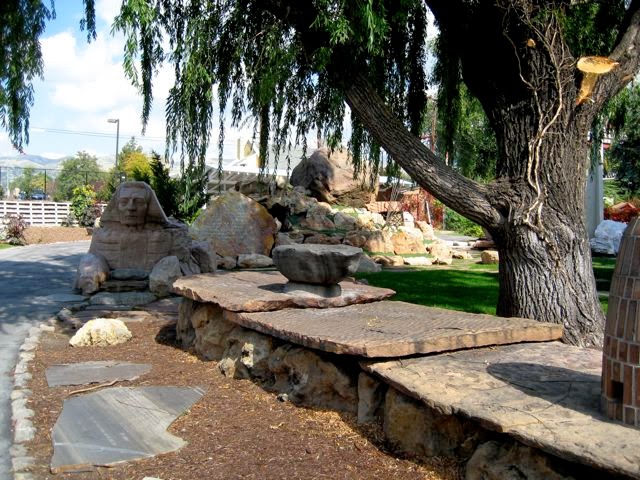
The Gilgal Sculpture Garden in Salt Lake City is a rather unusual place. The stone-carved sculptures and engravings were created by LDS Bishop Thomas Child, Jr. in the 1940s, and they portray numerous Biblical stories, and his Mormon religion. Most unusual has to go to the Joseph Smith Sphinx seen in this picture.
Utah boasts many kinds of museums. Seen in the photo is the giant beehive located inside of Discovery Gateway, a hands-on interactive children's museum, designed to please the young and the young-at-heart.
Other notable museums include the Alf Engen Ski Museum; the International Model Car Museum; the Browning Firearms Museum; the World of Puppetry Museum; and the Firefighters Museum. There are also numerous museums dedicated to natural history, fine arts, aviation, railroading, mining, and the American West and pioneer history.
What have we here? Looks like a big hole in the ground, and that's exactly what it is. But a special hole. This is Bingham Canyon Open Pit Copper Mine, the world's first (1904) and largest. And from what friends have told me, a fascinating place to tour.
This desolate looking place commemorates a sad chapter in American history: Topaz was a Japanese-American internment camp during WWII. (If you're curious about those camps, you can find a couple posts about them by clicking on the tag Gaman over there in my blog's sidebar.)
Zion National Park. Gorgeous, isn't it? [Credit: Doug Dolde]
At Timpanogos Cave National Park, you'll find three tourable caves, which are joined by man-made tunnels that were blasted back in the 1930s. And it doesn't just look cool. It is cool. The average temperature is 46 degrees F. (If you're looking for cold, head for the mountains. In the mountains near Salt Lake City, an average of 500 (that's five HUNDRED) inches of snow falls every year.
Here's the remains of a Hovenweep House, found at the Hovenweep National Monument. There, artifacts remain from Paleo-Indians from as early as 8000 B.C. These remains, however, are likely to be from the Pueblo Indians, circa 1150- 1350 A.D.
Ever hear of the Sundance Film Festival? Me, too, but I didn't realize it was held in Utah. Yep, and it's one of the largest independent film festivals in the U.S.
All you car buffs probably recognize this strange landscape. It's the Bonneville Salt Flats, famous for its five annual speed events, and for the many land speed records that have been set there.
Like the Great Salt Lake, this densely packed salt pan is a remnant of the Pleistocene Lake Bonneville. The lake covers 2100 square miles, and has an average depth of thirteen feet, and a deepest point stretching down to thirty-four. There's no water left at the flats, but there is bottomless excitement.
Care to get a taste of what it might be like to set a speed record on the salt flats? Fasten your seat belts...
Whew! Quite a ride, huh? Okay, time to settle down, and take a look at some of those bizarre laws. Remember, all states have 'em, and even though they're on the books doesn't mean they're enforced. (Thank goodness!) So what laws are still languishing on the books in the fine state of Utah? Let's see...
No one may have sex in the back of an ambulance if it's responding to an emergency call. (Better tell 'em to pull over.)
It's against the law to fish from horseback. (Wouldn't you think horses and fly-fishing would be a natural go-together?)
It's illegal not to drink milk. (I reckon that's one way to keep those gassy lactose-intolerant people away.)
It's against the law to detonate any nuclear weapon. (You can have one, maybe for show? Ya just can't blow it up. Sounds reasonable...)
Birds have the right of way on all highways. (MEEP! MEEP! Especially road runners.)
A husband is responsible for every criminal act committed by his wife while she is in his presence. (So she does the crime, and he does the crime? How terribly chivalrous.)
It's a felony to persistently tread on the cracks between paving stones on the sidewalk of a state highway. (I guess they take that old step on a crack, break your mother's back stuff seriously.)
It's against the law to hunt whales.
It's a no-no to allow biting in a boxing match. (Mike Tyson better stay away, especially if he's lactose intolerant.)
Alcohol may not be sold during an emergency. (I know some people who consider it an emergency if they run out of booze.)
It's illegal to cause a catastrophe. (So ya better not drop the last bottle of beer.)
In Kaysville, you must have an I.D. to enter a convenience store after dark. (Well, that isn't very convenient, is it?)
In Logan, ladies are expected to act like ladies. It's against the law there for women to swear. (Not even to tell the truth, the whole truth, and nothing but the truth?)
In Monroe, daylight must be visible between partners on a dance floor. (Sounds like the rule at the ol' '50s and '60s teen centers...)
It doesn't matter how perfect that snow is; in Provo, there's a whopping fifty-buck fine for throwing snowballs.
According to laws in Salt Lake City, it's illegal to walk down the street carrying a violin in a paper bag, and auctions may not advertise by hiring trombone players to play on the street. (No problem. Use a plastic bag, and give a tuba player the gig.)
In Tremonton, it's illegal to have sex in a moving ambulance, but if ya do, and get caught... the man is released. The woman, however, is punished, and her name appears in the newspaper. (So much for that aforementioned chivalry.)
In Trout Creek, pharmacists may not sell gunpowder to cure headaches. (If somebody eats gunpowder, do ya think his hair will grow out in bangs?)
***********************************************
Until next time, take care of yourselves. And each other.
[The image of the nifty now clock is courtesy of the fine folks at perfectlytimedpictures, and the rest of the pictures came from good ol' Wikipedia.]