Thought for the day: There is an unseen force which lets birds know when you've just washed your car. [Denis Norden]
Yeah, so maybe there are a few drawbacks to having a passel of bird-filled trees in your yard. (Especially if they're mulberry trees.)
I thought of something else pet birds taught me: One of my aunt's parakeets could hang upside down from its perch like a bat. It was the darnedest thing...
Okay, ready for some more astoundingly fascinating bird trivia? (Or at least, a teensy bit interesting, anyway.)
First, some quick facts:
Birds have hollow bones, which help them fly.
Seagulls can drink sea water, because they have special glands that filter out the salt.
A duck's quack doesn't echo.
Penguins can jump up to six feet into the air. (Yeah, but how are they on free throws?)
A chicken with red earlobes is likely to lay brown eggs; and one with white lobes, white eggs. No matter what color their earlobes are, none of them can swallow when upside down. And get this: believe it or not, the chicken is believed to be the closest living relative to the tyrannosaurus rex!
Emus can't walk backwards.
Puffins fly underwater.
The male sand grouse soaks himself in water, and then flies to the nest so his young can drink from his feathers.
Vultures can soar for hours without flapping their wings.
The common loon can dive more than 76 meters below the water's surface.
Owls can turn their heads almost 360 degrees, but they can't move their eyes.
The male frigatebird has a red inflatable throat pouch, which he puffs up to attract a mate. If he gets rebuffed, I guess that deflates his ego and pouch.
Flamingos can only eat when their heads are upside down. (How can they swallow?)
The albatross, AKA goony bird, can sleep while in flight. He goes into snooze control at about 25 MPH.
Talk about miles per hour, which bird do you think is the fastest flyer? Most sources say the peregrine falcon holds that title, and can reach a speed of 200 MPH. However, I read one report of a spine-tailed swift flying an astonishing 220. At any rate, how'd you like to get a vicarious thrill? This video allows you to experience flight with a peregrine falcon and a gos hawk. Pretty doggone cool!
Did you know storks have no voice? That's because, unlike other birds, they don't have a syrinx, the usual sound-producing organ. They do, however, bang and clack their bills together as a means of communication. (Looks like avian sword-fighting...)
Don't ya love the sound of a woodpecker at work? Unless, of course, he's a much earlier riser than you are... and he's hammering on your gutters, or fiberglass boat. Would you believe woodpeckers can peck up to twenty times per second?!
The fine-looking malleefowl lives in Australia, and I guess you could call this bird a real environmentalist. He composts. Sorta. The female lays her eggs in a nest built of rotting vegetation, and the decaying process keeps the eggs warm. Papa checks the temperature often, and adjusts the pile as needed to maintain the warmth.
The catbird is a talented bird, who can imitate... Wait! Not THAT catbird...
THIS catbird.
This catbird imitates other bird calls, and can even meow like a cat.
As can a mockingbird, who has quite an impressive array of sounds and songs in his repertoire.
And here's the mighty bald... er, wig-wearing bald eagle. One of the more majestic birds, (without the toupee) most people are well aware of this bird's flying, swooping, and hunting capabilities, and of its great strength.
But did ya know he could... swim?
Check it out!
This guy is a cowbird. No, cowbirds don't moo like cows, but they are cow groupies. They hang out with cattle, because moving herds stir up a mess of fresh cowbird food — insects. Because cowbirds stay on the move, they don't bother to build a nest. They share the nests of other birds. When the female sees an unattended egg-filled nest, she simply lays her little ol' eggs in there, too. She doesn't abandon her young entirely, though. She returns from time to time to observe, and if the other bird shoves her eggs out of the nest, well then, she may just have to retaliate by pushing the other eggs out, too.
That's about it from me. This barely even skims the surface of all the fascinating things there are to know about birds, and I'll betcha you could all add something. Like, anybody know about turkeys? Ben Franklin seemed to think they were intelligent birds, but I've read stories about them being so dumb they look skyward when it rains... and (bless their little hearts) drown. Izzat so?
And have you ever wondered why female blue jays don't have subdued coloring, like other female birds? I don't know if that's the case for any other species of birds; do you?
So, what have you got to add? Ever have any pet birds? Could they talk or do tricks? Do tell.
This is gonna be my last post for quite a while. I know a lot of you will be participating in the A-Z Challenge during the month of April, and I wish y'all a lot of fun with it. Not me. Not this year, anyway. Gonna take the month off and tend to some other writerly stuff. But I'll be around. I'll try to visit some of your blogs from time to time, and see how you're doing. If you leave me a comment here, I'll certainly respond, or if you want to get in touch with me, just use that little Email me thingie in the sidebar, and I'll get back to you.
In the meantime, if ya miss me, (and Johnny Carson) just watch this video... that myna sounds a little like me!
Until next time, take care of yourselves. And each other.
[Images come to us courtesy of Wikipedia, Seniorark, and Morguefiles.]
Thought for the day: A bird does not sing because it has an answer. It sings because it has a song. [Chinese proverb]
Are you a bird-lover? They're fascinating creatures, aren't they? Just about everyone on my mother's side of the family had pet birds when I was a kid, including us. Nothing too exotic. Mostly parakeets and canaries, but we had some tiny finches, too, and thanks to my brother, who was like a bird whisperer, we also had some wild birds living at our place for a while. Even a big ol' noisy crow.
On the other hand, my husband Smarticus didn't grow up with pets, so he wasn't particularly impressed years ago when a neighbor gave me two parakeets and a big cage. Nonetheless, I loved those birds, and to me, they filled the house with happy sounds.
Anyhow, since it's been a while since I wrote about things our pets have taught me, let's talk about birds, okay? Let's see, so what have I learned from birds...?
They, um, poop.
A lot.
If you let them out of the cage to fly, they poop.
A lot.
For every two seeds they eat, they scatter at least ten times that many out of the cage and onto the floor.
If you let them out of the cage to fly, they invariably crash into something.
And shed feathers.
And poop.
A lot.
Just because you think a bird is a male doesn't mean it won't lay eggs.
Birds are quite inquisitive. And smart. And beautiful
And maybe, just maybe, Smarticus is right. Maybe they don't belong in cages at all.
We think caged birds sing, when indeed, they cry. [John Webster]
Like I said, they're smart... (or maybe that cat isn't.)
Growing up, my mom always claimed to feel bad when a bird would slam head-first into our living room window. If she really felt bad, though, she'd have moved the bird feeder outside. [Rich Johnson]
How's about some interesting trivia about some of our feathered friends?
I'm sure everyone recognizes this handsome couple. Reaching heights of up to nine feet tall, not only are ostriches the largest birds, but they're also the fastest runners. Would you believe they can hustle up to an astounding 97 km/hour? So don't let their girth fool you; these critters can MOVE! Oh, and even thought the thought of it is somewhat amusing, contrary to popular belief, ostriches do NOT bury their heads in the sand.
As you can see, their eggs are kinda on the large size, too. About the size of a cantaloupe. And if you're ever thinking about hard boiling one, you'd better not be too hungry. It takes about two hours.
At the other end of the spectrum is the hummingbird, the only bird capable of flying backwards. The bee hummingbird is the smallest of the group, and only measures about two inches. (5 cm) However, in spite of the hummingbird's skillful flying and hovering capabilities, along with the loon, swift, kingfisher, and grebe, it cannot... walk.
Seen here is a spot-billed pelican feeding her young. Early mythology believed that when they couldn't find food, pelicans actually ripped at their own bodies, and used their own flesh and blood to feed their young... which explains why some churches later adopted the pelican as a symbol of Christ's sacrifice.
A wonderful bird is the pelican,
His bill will hold more than his belican.
He can take in his beak
Food enough for a week,
But I'm damned if I see how the helican.
[Dixon Lanier Merritt- 1905]
Here's a beauty for ya. Okay to look, but don't touch. The pitohui is the only known type of bird with feathers and flesh poisonous enough to kill a human. But don't worry. You aren't too likely to run into one of these fellows, because they only live in New Guinea. It's very easy to remember his name, though. It's pronounced just like the spitting sound someone might make if he were foolish enough to taste this bird: pa-tooo-ey!
Birds are, um, excellent parents.
And they never ever favor one baby over another.
And all in all, they can be pretty darned entertaining, too.
How entertaining, you ask? Just watch...
Okay, better, um... fly. Our cats are watching, and for some reason they're raising a real ruckus. I do believe they're... hungry. Go figure. Okay, more about da birds next time. Until then, take care of yourselves. And each other.
You have to believe in happiness,
Or happiness never comes...
Ah, that's the reason a bird can sing —
On his darkest day, he believes in Spring.
[Douglas Malloch]
[Images comes to us courtesy of Wikipedia, Icanhascheezburger, Seniorark, and Morguefiles.]
Thought for the day: Two boll weevils grew up in South Carolina. One went to Hollywood and became a famous movie star, while the other one, a bit of a slacker, stayed behind in the cotton fields and never amounted to much. I guess you could say the second one was the lesser of two weevils.
palmetto trees
Okeydokey, it's time for another whirlwind tour. Up this week: the lovely little state of South Carolina, AKA the Palmetto State.
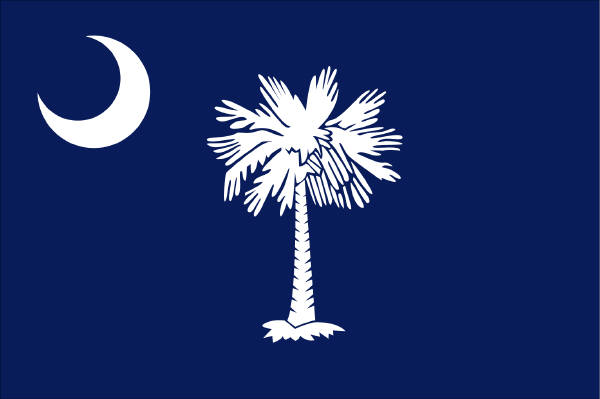
A fitting nickname, don't you think? I mean, not only are there more palmettos in South Carolina than there are Republicans in Texas, but the tree has a certain claim to fame in the state's history, as well. As the story goes, the walls of the American fort on Sullivan Island in Charleston Harbor were built with palmetto logs. Spongy palmetto logs. How spongy, you say? During the Revolutionary War, British cannonballs allegedly bounced right off of them. Now, I'm not saying the story is true, and I'm not saying it isn't true. But you have to admit, it's an interesting tale.
Before South Carolina adopted the Palmetto nickname, it was known as the Iodine State, a rather stinging moniker that stained the state's good name. Okay, so it wasn't an awful nickname, but not nearly as pleasant as the image of palm trees swaying in the breeze, either. The state is also a big rice grower, and boasts the largest gingko farm in the world. The gingko, the oldest living tree specimen in the world, dates back 150 to 200 million years, and is actually considered a living fossil. So South Carolina folks should be happy their state motto isn't something about it being the home of living fossils. (Some senior citizens might take offense at that...)
Okay, enough chatter. Let's check out some pictures, shall we?
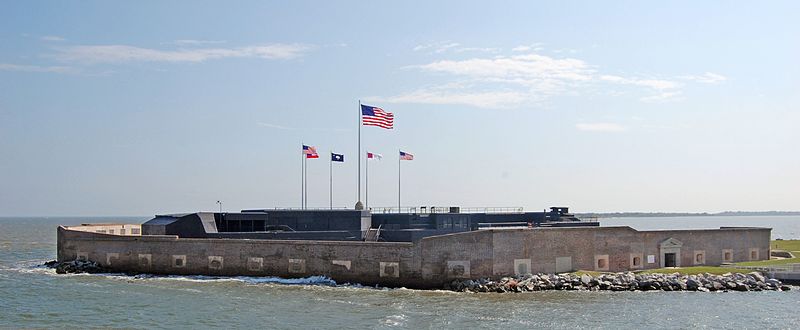
Fort Sumter, located in Charleston Harbor, is the historical site of the first Civil War battle.
Cowpens National Battlefield, a Revolutionary War historical site, is located in Chesnee. There, you can see some of the original settlers' cabins like this one at the left.
Not to be confused with the battlefield, there is also a Cowpens Depot and Museum located in the city of Cowpens. Housed in a 100-year-old train depot, this museum is a showplace for relics belonging to the crew of the U.S.S. Cowpens, a WWII aircraft carrier.
This is an 1860's artist's sketch of the Confederacy's submarine the Hunley, which was discovered and raised from her watery grave in 2000. She is now preserved in a 90,000-gallon tank in Charleston's Hunley Museum, where you can also see numerous artifacts and learn all about this fascinating 40-foot craft and the men who served as her crew.
But South Carolina isn't all about military war. No sirree, it's also about a war of... peaches. Although South Carolina is the largest producer of peaches in the country, Georgia had the temerity to call itself the Peach State. No problem. Gaffney, South Carolina built the Peachoid, a water tower that looks like a giant peach. This distinctive landmark, clearly visible from the Interstate, delivers a silent non-combatant message, as it stands proudly in the midst of miles and miles of peach groves and stands offering everything peachy for sale. (And yes, Georgia also has a peachy water tower, but not on the Interstate.)
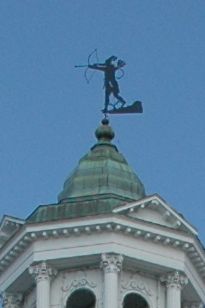
Depicted in this life-size weather vane atop the 1886 Opera House in Camden is a noble Catawba Indian named King Haigler. He's known as the patron saint of Camden because of the way he befriended and helped early settlers in the area.
The Grand Strand is an exquisite arc of beach lands that stretches more than sixty miles. Pictured at left is Myrtle Beach, one of the many popular vacation destinations along the coast. This part of the state brings to mind such things as sea oats, sandpipers, boating, fishing, crabbing, seafood, beach music and boardwalks. Places where you can have fun in a crowd, or enjoy a secluded walk on the beach at sunrise.
Oh, and along with beach music, we can't forget to mention the shag, the official state dance. This swing dance originated in South Carolina in the '20s, and is still wildly popular today. In some ways, it's very similar to the jitterbug, but ... smoooooother. Wanta see?
The Thoroughbred Racing Hall of Fame can be found in Aiken, South Carolina.
Irmo's Lake Murray looks lovely, doesn't it? Hiding beneath its tranquil surface may dwell a mysterious monster. Its first reported sighting came in 1973, and every few years since, numerous additional sightings have been reported. Invariably described as a cross between an enormous snake and a prehistoric monster, it sounds like a cousin to the famous Nessie.
One more short video before we move on to check out some of the nutso laws, okay? Fountain Head, South Carolina's most famous native son is Clayton "Peg Leg" Bates. He lost his leg in a cotton gin accident at the age of twelve, but that didn't stop him. He went on to become a famous dancer, who appeared on Ed Sullivan's show many times. Here's a peek at him in action:
If you'd like to get a real feel for South Carolina, I suggest you read some of Pat Conroy's books. Not only will you fall in love with his writing and stories, you just may become a little enamored with the state itself. Walking the streets of Charleston in the late afternoons of August was like walking through gauze or inhaling damaged silk. [Pat Conroy]
Okay, ready to check out some of those cockamamie laws still hanging out on the books in South Carolina?
By law, if a man promises to marry an unmarried woman, the marriage must take place. (Um, suppose he is already married?)
Railroad companies may be held liable for scaring horses.
Fortune tellers must obtain a special permit from the state.
Dance halls may not open on Sundays, and no work may be done on Sundays, but it is legal for a man to beat his wife on the courthouse steps on a Sunday. (Don't lift a finger on the Sabbath, unless it's to keep the little woman in line?)
Musical instruments may not be sold on Sundays, but light bulbs can. (Ah-HA! I see de light!)
It's against the law to perform a U-turn within one thousand feet of an intersection.
It's considered an offense to get a tattoo. (Well, yeah, some of them are pretty offensive.)
Horses may not be kept in bathtubs. (What the hay?)
It's only legal to fire a missile if you get a permit. (All righty then.)
Every adult male must bring a rifle to church on Sunday to ward off Indian attacks. (Believe it or not, a similar law is being considered by our state politicians right now.)
It's a capital offense to accidentally kill someone while attempting suicide. (Oopsie.)
Watch out! In Charleston, the fire department is allowed to blow up your house.
In Clemson, lifeguards must be present at apartment complex pools, but um... only after 11:00 P.M.
Also, bitches in heat must be confined. (Can they have gentlemen callers?)
In Fountain Inn, horses must wear pants at all times.
In Greenville, the drinking age on Furman University campus is sixty.
In Lancaster county, it's illegal to dance in public.
And finally, in Spartanburg, it's against the law to eat watermelon in the Magnolia Street cemetery.
Ordinarily, this is where I'd tell you it's time for (ta-DA!) The Weirdest News Stories of the Week, but not this time. This is the final week for Suze's Tiny Harmonies haiku challenge, so I'm gonna end this post with that. She didn't provide a picture to go along with her themes this time, so I'll pick my own. Three themes to choose from this week, too: quench, the real, and loam. Or, do all three... Okay, let's see what I've got:
This tiny otter is harmoniously quenching HIS thirst.
From cradle to grave, The wise man's thirst for wisdom Will never be quenched. *** Anyone know me? Not the aging shell you see— The real soul I am. *** Dirt, dark as coffee, Sweet verdant stubble of spring: Rain-blessed scents of life.
How about you? Care to try your hand at writing a haiku as part of your comment? The basic formula is three lines consisting of five, seven, and then another five syllables. (Watch out! It's addictive!) Thanks, Suze.
Until next time, take care of yourselves. And each other.